

Trivago is engineered to avoid the experience of booking the same room, for the same dates and see that they can have a different price on almost every website you visit.


This market fragmentation makes it challenging to know if you are getting a good deal or leaving money on the table. Trivago operates as a specialized search engine that scans hundreds of booking platforms simultaneously to find the lowest available price for a given hotel.
Defining Trivago’s Role: The Aggregator
The first step to using Trivago effectively is understanding what it is not. Trivago is not an online travel agency (OTA) like Booking.com or Expedia. It is a metasearch engine. Its core purpose is not to sell you a room directly, but to index and compare prices from hundreds of other OTAs and sometimes the hotel’s own website. It is a research tool designed to provide a comprehensive market overview before you commit to a purchase.
The platform’s effectiveness is rooted in its scope and scale. Trivago aggregates data for over 5 million properties across more than 190 countries, pulling real time prices from a vast network of booking partners. This extensive reach is what allows it to present a truly wide spectrum of options, from global chains to independent boutiques. This makes it a powerful resource for comparing Trivago hotel prices in major cities and popular tourist destinations.
This aggregator model is its key differentiator. While an OTA’s goal is to sell you a room from its own inventory, Trivago’s goal is to show you every available option, regardless of the seller. This creates a level of price transparency that is difficult to achieve by visiting individual sites manually. The question it answers is simple: “Where is the cheapest place to book this specific hotel?”
Trivago User Workflow: Search, Compare, Book
The user experience is straightforward and built for efficiency. It begins with the search process: you input your destination, travel dates, and guest number. Trivago then returns a list of available hotels. Next to each hotel, you see a range of prices from different booking providers, with the lowest price highlighted prominently.
This leads into the comparison phase. Here, Trivago’s tools become valuable. You can filter results by price range, guest rating, amenities like free WiFi or parking, and use an interactive map view to see how close hotels are to key landmarks. A particularly useful feature is the aggregated guest rating, which compiles scores from multiple review sites into a single, simplified score, offering a quick, consensus based view of a property’s quality.
The final step is the booking redirect. Once you select a deal, you click on the price, and Trivago redirects you to the corresponding booking website (e.g., Expedia, Agoda, the hotel itself) to complete the reservation. This is a critical point to understand: the actual transaction, customer service, and terms and conditions are all handled by the third party site, not by Trivago.
Trivago Core Value
The primary value proposition is undeniable price transparency. The ability to see the full price spectrum for a single hotel in one glance is Trivago’s greatest strength. This transparency can lead to significant savings, especially for travelers who are flexible or booking well in advance.
A major secondary benefit is time efficiency. The platform eliminates the tedious process of opening a dozen browser tabs to compare prices across Expedia, Booking.com, Hotels.com, and others manually. What might take 30 minutes of manual searching can be accomplished in 30 seconds on Trivago.
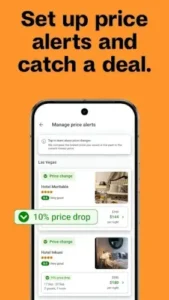
The deal discovery features add another layer of value. Setting a price alert for a specific hotel and dates can notify you of a discount, allowing you to book at an optimal time. Similarly, exclusive mobile app rates can provide savings not available on desktop websites. The aggregated review score also contributes to more informed decision making by providing a broader perspective on a property’s quality than any single source might offer.
The app holds a 4.7 star rating from over 350,000 reviews, is rated for ages 3+, and has a download size of approximately 80 MB. For a similar approach focused more on flights, Skyscanner is a comparable metasearch app.
The most important practical consideration involves the booking partner relationship. After you are redirected from Trivago, your contractual relationship is solely with the booking partner. If you need to modify, cancel, or have any issues with your stay, you must contact that third-party company directly, not Trivago. Understanding this chain of responsibility is crucial.
Users should also be aware of price accuracy. While Trivago’s data is updated regularly, hotel prices are dynamic and can change in real time. There is a small chance the price you see on Trivago might differ slightly from the final price on the booking site due to this latency.
Finally, while the interface is clean, the sheer volume of options and providers can be overwhelming. Distinguishing between similar prices from different OTAs requires careful attention to the terms each one offers, such as cancellation policies or included fees, which may not be immediately visible in the initial price listing.
Trivago’s Position in the Market
To fully appreciate Trivago’s value, it’s helpful to compare it to other platforms often categorized as Trivago similar apps. Each serves a distinct purpose in the travel planning process. Google Hotels is Trivago’s most direct competitor in the metasearch space, offering similar price comparison functionality with deeper integration into Google’s ecosystem, like linking with Google Flights.
Booking.com and Expedia operate on a different model as online travel agencies (OTAs). They actually inventory and sell rooms directly. While they may show their own prices on Trivago, their primary goal is to convert searchers into bookers on their own platforms. Trivago’s advantage is its neutrality, it doesn’t prioritize its own inventory because it has none.
Tripadvisor serves a different need altogether, focusing heavily on reviews, photos, and travel forums. While it does show prices, its strength is in helping you decide which hotel to book based on quality and experience, whereas Trivago helps you find the best price for a hotel you’ve already selected.
This context defines Trivago’s ideal use case. It’s most powerful when you have a specific hotel or narrow list of hotels in mind and want to quickly compare prices across the entire market. This is a crucial Trivago tip: use it for price comparison after you’ve narrowed down your hotel choices, not for initial hotel discovery based on quality or amenities.
Practical Tips for Maximizing Trivago
Several strategies can help you get the most value from the platform. First, always double check the final price before booking. While Trivago shows the base room rate, the third party site may add taxes, fees, or resort charges that change the total cost. This is one of the most important Trivago booking tips for avoiding surprises.
The price alert feature is particularly valuable for flexible travelers. Setting alerts for your desired hotels and travel dates can help you identify pricing patterns and book when prices drop. However, understand that prices can change rapidly, especially during high demand periods.
When comparing prices, pay attention to the booking terms attached to each rate. A slightly higher price that includes free cancellation or breakfast may offer better value than the absolute lowest price with restrictive terms. The map view is especially useful for verifying location, what appears to be a great deal might be for a hotel far from your actual destination.
For complex trips involving flights and hotels, you might find better package deals on dedicated OTA sites. Trivago focuses specifically on hotel pricing, which is its strength, but may not capture bundled savings available elsewhere.
Conclusion :
Trivago’s core strength remains its ability to bring unprecedented transparency to hotel pricing. In a market where the same room can have dramatically different prices across various platforms, Trivago serves as an essential market research tool that puts power back in the traveler’s hands.
The most balanced perspective recognizes that Trivago is optimized for price comparison rather than being a comprehensive travel planning solution. Its value peaks during the booking phase when you need to verify you’re getting the best available rate for your selected accommodation.
For travelers who value financial efficiency in their hotel bookings, Trivago represents an indispensable first step. The platform’s ability to scan hundreds of booking sites simultaneously makes it arguably the most efficient way to perform due diligence on hotel pricing. The most practical approach is to use Trivago as your final price check before completing any hotel booking, ensuring you have complete market visibility before making your purchase decision.
While the actual booking experience happens on third party sites, the confidence gained from knowing you’ve found the best available price makes Trivago a valuable component of modern travel planning. The time saved alone in manual price comparison makes it worth including in your travel toolkit, even if you ultimately book directly with a hotel or preferred OTA.
FAQ
How does Trivago make money if it’s free to use?
Trivago operates on a metasearch model, earning commission from booking partners when users click through to their sites and complete a reservation. The platform provides value to hotel booking sites by sending them qualified traffic, creating a sustainable business model that keeps the service free for travelers.
What is the process for a Trivago download and is the app free?
The Trivago app is completely free to download and install from the Google Play Store. For technical support with the application, you can contact the development team at mobile[at]trivago.com.
Are the prices shown on Trivago always accurate?
While Trivago updates prices frequently, hotel rates can change in real time. The prices shown are generally accurate, but there may be occasional discrepancies due to timing delays. Always confirm the final price on the booking site before completing your reservation.
What should I do if I have problems with my hotel booking?
Since Trivago is a price comparison platform rather than a booking agency, any issues with reservations must be handled directly with the booking site you used (such as Booking.com, Expedia, or the hotel’s website). Your booking confirmation email will contain the appropriate contact information for customer service.
How does Trivago compare to booking directly with a hotel?
Trivago often shows prices from the hotel’s own website alongside third party booking sites. While booking directly can sometimes offer better customer service flexibility, third-party sites may have exclusive discounts. Trivago helps you see all options simultaneously, allowing you to make an informed choice based on price and terms.