

Babbel try to fix the moments when someone speaks to you in another language and your brain still scrambles to form a sentence. You know words. You do not know how to put them together in real time.
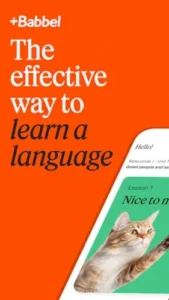

Babbel use structured lessons, clear grammar explanations, and speech recognition that checks your pronunciation. Fourteen languages. Ten to fifteen minute lessons. Expert designed, not crowdsourced.
Here is what you get. A 4.5 star rating from over 1.000,000 reviews on Google Play. App size is about 89 MB. Age range is 4 and up, but the real audience is teenagers and adults who want real conversation skills, not just high scores.
If you like structured learning with grammar focus, you might also enjoy Busuu. It offers similar CEFR based lessons with community corrections.
Back to Babbel. The question is not whether you can tap the right answer. The question is whether you can speak a sentence without freezing.
A quick note on Babbel app requirements. Works on Android 8.0 and up. Offline mode available with subscription. Free users get a limited preview.
So what makes Babbel different from Duolingo? Duolingo feels like a game. Babbel feels like a class. Both work. They just serve different learners. Keep reading to see which one fits you.
What Is Babbel?
Babbel is a language app built around structured lessons and real conversations. Not games. Not random vocabulary. Expert designed courses that teach you to speak in everyday situations. Fourteen languages. Ten to fifteen minute lessons. Speech recognition that checks your pronunciation. Grammar and vocabulary built into every session.
The app launched in 2007. It has grown into one of the few paid language apps that people actually recommend. Why? Because the lessons work. They are short enough to fit into a commute. Long enough to teach something real.
You still learn vocabulary. You still practice grammar. But every lesson ties back to a real situation. Ordering coffee. Asking for directions. Making small talk at a party. No abstract sentences about the pen on the table.
That is the Babbel difference. It assumes you want to speak, not just pass a test.
For anyone searching Babbel review before subscribing, here is the short version. The app excels at structured progress and pronunciation practice. It struggles with advanced content depth. Use it for A1 to B2. That is where it shines.
How Babbel Differs from Gamified Language Apps
Gamified apps keep you tapping. Babbel keeps you learning. The difference shows up in the lesson design. No fake currency. No leaderboards. No cartoon rewards. Just clear explanations, practical phrases, and speech practice that actually listens.
The app assumes you want to learn, not just play. That focus changes everything about how lessons are built.
Here is a concrete example. A gamified app teaches you “manzana” with a picture of an apple. You tap it. You move on. Babbel teaches you “una manzana” and then asks you to say “I eat an apple” out loud. The speech recognition listens. It tells you if your pronunciation sounds like a native speaker or not. Then it explains why “una” changes to “un” before certain words.
That extra step takes thirty seconds. It makes the difference between memorizing a word and actually using it.
If you are looking at Babbel vs Rosetta Stone, here is the breakdown. Rosetta Stone uses immersion. No translation. No explanations. You figure it out from pictures. Babbel uses translation and clear grammar explanations. Rosetta Stone is for people who hate rules. Babbel is for people who want to understand the rules.
Babbel Features
14 languages
Spanish, French, German, Italian, and more. All with the same lesson structure. No matter which language you pick, the quality stays consistent.
10 to 15 minute lessons
Short enough for a commute. Long enough to learn something real. You can finish one lesson while waiting for coffee. That low barrier to entry matters.
Real life conversation focus
Ordering food. Asking for help. Making small talk. Not textbook dialogues about library cards and train schedules. Babbel teaches what people actually say.
Speech recognition technology
The app listens. It tells you if your pronunciation works or needs work. You see a waveform. You record yourself. The app compares your voice to a native speaker. That feedback is instant. No waiting for a tutor.
Grammar explanations
Built into lessons. Not separate. You learn the rule when you need it. No flipping to a grammar section. No confusion about why a sentence is structured that way.
Vocabulary practice
Themed around real situations. Not random word lists. Each lesson introduces five to seven new words. Then you see them again in review. Then again in conversation practice.
Review sessions
Adaptive. They focus on your weak spots, not what you already know. The app tracks which words and rules you struggle with. Review sessions target exactly those gaps.
Learning reminders
Push notifications that actually help. Set a time. The app respects it. No random notifications at 2 AM. Just a quiet nudge at your chosen time.
Babbel Looks and Feel
Clean interface. Polished. Calm. Uncluttered. Each screen has one job. Listen. Speak. Read. Write. Not all at once. The design priority is focus, not flash.
No cartoon characters. No dancing owls. Just a professional layout that gets out of your way. Progress bars show where you are. Colors are muted. Navigation is simple.
The color scheme uses white backgrounds with orange accents. Buttons are clearly labeled. The bottom navigation has four tabs. Learn. Review. Profile. More. You never get lost.
For anyone wondering how to use Babbel effectively, the interface gives you hints. A checkmark appears when you complete a lesson. A progress ring fills as you move through a course. The app trains you to trust the structure, not fight it.
What Babbel Users Say
What people like:
Lesson structure feels serious and useful. Users appreciate that Babbel does not waste their time with cartoon rewards. The app respects that you are an adult with real goals.
Speech recognition helps with pronunciation. Users report sounding more natural after using the feature for a few weeks. The app catches mistakes your ear misses.
The app respects your time with short lessons. Fifteen minutes. Done. No commitment to hour long sessions.
What people complain about:
Speech recognition is not perfect. It works best in quiet rooms with clear microphones. Background noise confuses it.
Auto renewal and billing issues come up. Some users report being charged after canceling. Read the cancellation policy carefully.
Some users want more content depth at advanced levels. Babbel works best for A1 to B2. C1 content is thinner.
Even with those complaints, the rating stays strong. 4.5 stars from over 1.000,000 people. That many ratings do not lie. The app delivers structured progress.
A common Babbel review theme is this. The app works best for motivated beginners and intermediate learners who want clear grammar explanations. Casual learners may find the paid subscription expensive. Serious learners find the speech recognition worth the price.
Babbel Tips
You do not need more time. You need better habits. Here are seven Babbel tips that turn the app from a lesson completer into a skill builder that actually improves how you speak.
Use Babbel consistently in short sessions
No cramming. Fifteen minutes every day beats two hours on Sunday. The Babbel app tracks your consistency. A daily streak is not just a number. It is a signal to your brain that this matters. Short sessions keep the material fresh. Long sessions cause burnout.
Turn on reminders
Let the app help you build a routine. Pick a time. Morning coffee. Lunch break. Right before bed. Set the reminder. When it goes off, do the lesson immediately. Do not snooze. Do not say later. The reminder is not annoying. It is a tool. Use it.
Repeat review sessions regularly
That is where memory sticks. New lessons teach you something. Review sessions make sure you keep it. The Babbel app schedules reviews based on when you learned each word. Trust that schedule. A word seen five times with gaps beats a word seen fifteen times in one sitting.
Pay close attention to speech recognition feedback
The app hears what you cannot. Your ear misses small pronunciation errors. The microphone catches them. Record yourself. Listen back. Compare to the native speaker. Repeat until the waveform matches. This is the most valuable Babbel tip for anyone who wants to sound less like a textbook.
Focus on conversation lessons first if speaking is your goal
Grammar lessons matter. Vocabulary lessons matter. But conversation lessons tie everything together. Start there. Learn a phrase. Practice saying it. Use it in the dialogue exercise. The other lessons fill in the gaps later.
Supplement Babbel with real listening outside the app
Podcasts. Music. TV shows. News in your target language. Fifteen minutes of Babbel plus fifteen minutes of real listening doubles your progress. The app teaches you patterns. Real listening teaches you speed, slang, and natural rhythm. Use both.
Choose a consistent time of day
Same time. Same place. Same habit. Your brain learns better when it expects the lesson. Morning learners absorb faster. Evening learners retain longer. Pick one. Stick to it. The time matters less than the consistency.
Are you using Babbel app as a daily tool or a weekly chore?
How Babbel Compares to Other Apps
| App | Main Difference |
|---|---|
| Duolingo | More gamified, less grammar explanation |
| Busuu | Includes community corrections, similar structure |
| Memrise | More video and AI, less structured grammar |
| Rosetta Stone | Immersion focus, less short session friendly |
| Drops | Vocabulary only, no conversation or grammar |
Babbel sits closer to Busuu in structure. But Babbel has no community corrections. It relies on expert designed lessons and speech recognition instead of peer feedback. Less game like than Duolingo. More grammar than Memrise. Shorter sessions than Rosetta Stone.
Here is a question. Do you want corrections from random native speakers or feedback from speech recognition software?
One more comparison people search for. Babbel similar apps versus Pimsleur. Pimsleur is audio only. Thirty minute sessions. Great for driving. Terrible for visual learners. Babbel gives you text, audio, and speech feedback. Three ways to learn the same material.
Pick Babbel if you want clear grammar and structured lessons. Pick Duolingo if you want free gamified practice. Pick Busuu if you want community corrections. Pick Memrise if you want video clips of native speakers. Different tools for different learners.
Babbel Community. Quiet but Supportive.
Babbel is not a social app. There are no leaderboards. No peer corrections. No public profiles.
But the community exists through shared learning habits, live classes in Babbel Live plans, and user support resources. For many learners, that quiet focus is a feature, not a bug. No pressure. No competition. Just you and the language.
Here is what that means in practice. You do not see how many people are ahead of you. You do not get notifications that someone corrected your sentence. You do not feel the pressure to perform for an audience.
Some people need that pressure. They thrive on competition. If that sounds like you, Babbel may feel too quiet.
Other people find leaderboards stressful. They want to learn at their own pace without comparison. For them, Babbel is perfect.
Babbel codes sometimes appear for subscription discounts. Look for them on language learning forums, Reddit, and deal websites. A working code saves you money on a yearly plan. Search before you pay full price. Some codes work for the first month only. Others apply to annual plans.
The Babbel Live feature adds a different kind of community. Small group classes with real teachers. You speak. You listen to other learners. You get live feedback. That option costs extra. But it turns Babbel from a solo app into something closer to a real classroom.
So here is a question. Do you learn better alone or with a group watching you?
So. Does Babbel Work?
Yes. For what it tries to do.
Babbel will not make you fluent alone. No app can. But it gives you something many apps skip. Real grammar explanations. Speech recognition that checks your pronunciation. Lessons built by experts, not crowdsourced.
The free tier is limited. You pay for Babbel. That is real. But for learners who want structure and practical skills, Babbel delivers.
Here is a final question before you subscribe. How many free apps have you tried that left you still unable to form a sentence out loud?
Try it for thirty days. One lesson each day. Use the speech recognition every time. After a month, try speaking to a native speaker. The difference will show.
Most people never get that far. Not because they are bad at languages. Because they chose apps that only ask for recognition, not production. Babbel asks you to speak. Then it tells you if you sound right.
If that sounds like what you need, the app works. If you want free games and leaderboard trophies, look elsewhere. Honest answer. No fluff.
A final Babbel app note. The subscription auto renews. Set a calendar reminder a few days before the renewal date. Decide then if you want to continue. That one habit saves people from surprise charges every year.
FAQ
How do I get Babbel on my phone?
Babbel download is simple. Open Google Play, search Babbel, tap install. The app is free to try. Size is about 45 MB. Works on most Android phones from the last five years. After install, pick a language. The app asks your current level. Be honest. Starting too high leads to frustration. Starting too low leads to boredom.
Google Play link: Download Babbel from the Official Google Play Store
Is Babbel really free or do I have to pay?
The free tier gives you a preview. One or two lessons per language. Enough to see if you like the style. After that, you need a subscription. Monthly, quarterly, or yearly plans. Babbel is not a free app. It is a paid app with a free trial. The price is real. But users consistently say the structured lessons are worth the cost.
Official website: www.babbel.com
Where can I read more about how Babbel started and the research behind it?
The Wikipedia page covers the company history, the team of linguists who design the lessons, and how Babbel differs from crowdsourced language apps. It also explains the speech recognition technology and why the app focuses on 15 minute lessons.
Wiki page: Babbel on Wikipedia
What if I find a bug or need help with my account?
The support team responds faster through email than social media. Include your username, a short description of the issue, and your phone model if the app crashes. If speech recognition is not working, mention your phone model and Android version. Some microphones work better than others.
Developer email for support: support[at]babbel.com
Can I really learn a language with just 10 minutes a day?
Yes and no. Ten minutes a day builds vocabulary and grammar knowledge. You will understand more. You will read better. But speaking fluently requires real conversation. Use Babbel for structure. Use podcasts, music, and TV shows for listening. Use actual conversations for speaking. The 10 minute lessons build the foundation. You build the rest.