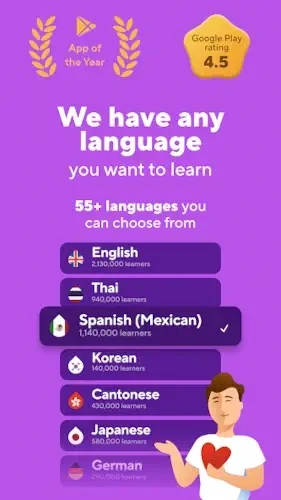
Drops make you value that 5 minute waiting for a bus or standing in line for coffee or maybe hiding in the bathroom before a meeting starts. Most language apps need ten or fifteen minutes. You do not always have that.
Drops fits into the gaps. Five minutes. That is it. No grammar lectures. No long reading passages. Just visual flashcards, fast mini games, and audio from native speakers. You learn words. You remember them because the app shows you the same word again and again in different ways.
Here is what you get. A 4.7 star rating from over 302,000 reviews on Google Play. App size is about 156 MB. Age range is 4 and up, but the real audience is teenagers and adults who want quick vocabulary wins without the pressure of long lessons.
If you like visual learning with short sessions, you might also enjoy Memrise. It focuses on vocabulary with video clips of native speakers.
Back to Drops. The question is not whether you have time to learn. The question is whether you will use the five minutes you already waste scrolling.
A quick note on Drops app requirements. Works on Android 7.0 and up. Offline mode available with premium. Free users get five minutes per day. That is the catch. Five minutes free. Then the app locks until tomorrow.
So what makes Drops different from Duolingo? Duolingo teaches sentences and grammar. Drops teaches single words with pictures. Duolingo is a meal. Drops is a snack. Both fill you up. Just differently.
What Is Drops?
Drops is a language app built around visual vocabulary learning and short sessions. Five minutes a day. Illustrated flashcards. Fast paced mini games. Audio pronunciation from native speakers. No grammar. No long explanations. Just words, pictures, and repetition.
The app launched in 2015. It has grown into one of the most visually distinctive language apps on the market. The design won awards. The gameplay keeps people coming back. But the focus is narrow. Vocabulary only. That is intentional.
You learn words by theme. Food. Travel. Work. Family. Each theme has twenty to fifty words. You see a picture. You match it to a word. You hear the pronunciation. You swipe. You tap. You drag. The games change every few seconds so your brain stays alert.
That is the Drops difference. It does not try to teach you everything. It tries to teach you words. And it does that very well.
For anyone searching Drops review before downloading, here is the short version. The app excels at visual vocabulary retention and short session consistency. It struggles with grammar and sentence structure. Use it to build word knowledge. Pair it with something else for full language learning.
How Drops Differs from Traditional Language Apps
Traditional apps teach you to read and write. Drops teaches you to recognize. The difference shows up in the game design. No typing. No sentence construction. Just matching pictures to words, hearing audio, and repeating until the word sticks.
The app assumes you want to build vocabulary fast without the friction of grammar rules. That focus makes Drops feel more like a game than a class.
Here is a concrete example. A traditional app teaches you “manzana” with a picture of an apple. Then it asks you to write a sentence using “manzana.” Drops shows you the same picture. You match it to the word “manzana.” Then you match it again. Then you hear it. Then you match it one more time in a different game. No writing. No pressure. Just repetition with variety.
That approach works for one thing. Vocabulary. It does not work for conversation. You cannot learn to speak by matching pictures. But you can learn hundreds of words that way. Fast.
If you are looking at Drops vs Anki, here is the breakdown. Anki is a flashcard system. Powerful. Ugly. Flexible. Drops is a polished game. Less flexible. Prettier. Easier to stick with. Anki is for serious memorization nerds. Drops is for everyone else.
Drops Features
Game first vocabulary lessons
Fast, short sessions. Each game lasts thirty to sixty seconds. You match. You sort. You tap. You drag. The app changes the game type every few rounds so your brain does not zone out.
Illustrated flashcards
Words pair with memorable images. Not stock photos. Not clip art. Custom illustrations that match the word in a way that sticks in your memory. You see a drawing of a dog. You learn the word for dog. Simple.
Spaced repetition
The app tracks which words you struggle with. It shows those words more often. Words you know appear less often. That timing is based on memory research. The Drops app schedules reviews exactly when you are about to forget.
3,000 plus words and phrases
Curated by linguists. Not crowdsourced. Each word was chosen because it appears frequently in real conversation. No obscure vocabulary. Just useful words.
Audio pronunciation
Correct dialect support. Spanish from Spain sounds different from Spanish from Mexico. Drops lets you choose. The audio is clear. The speed is natural. You hear the word. You repeat it. The app does not judge your pronunciation. But you hear the difference.
Offline practice
Keep learning without internet access. Download a theme at home. Practice it on a plane, a train, or anywhere without signal. Premium feature. Worth it for frequent travelers.
Alphabet and script learning
Non Latin writing systems. Hangul for Korean. Hiragana and Katakana for Japanese. Arabic script. Hebrew. Chinese characters. The app teaches you to recognize the shapes, not just the sounds. That separate feature is more useful than most people expect.
Progress tracking, achievements, and streak support
Five minutes a day keeps the streak alive. The app tracks your consistency. Achievements pop up when you hit milestones. Small rewards. Low pressure. But they work.
Drops Looks and Feel
Polished and playful. Bright colors. Smooth animation. Simple hand drawn or icon like visuals. Minimal layout that keeps focus on the learning task.
The design is intentionally easy to use with one handed navigation. Fast transitions between exercises. That makes it feel more like a casual game than a traditional language course.
Colors are bold. Purple backgrounds. White text. Colorful illustrations. The app does not look like a classroom. It looks like a mobile game. That is the point. If it looked like work, you would treat it like work. Drops looks like play. So you play.
For anyone wondering how to use Drops effectively, the interface gives you hints. A timer counts down your five minutes. A progress bar fills as you learn new words. The app trains you to move fast. Hesitation wastes your limited time.
What Drops Users Say
What people like:
The app is genuinely fun. Users report looking forward to their five minutes instead of forcing themselves to study.
Visuals help with memory. The custom illustrations stick in your head. Weeks later, you see a dog and remember the word because you remember the drawing.
Short sessions fit any schedule. Five minutes is nothing. You can do it while waiting for anything.
What people complain about:
Only five minutes free per day. That is the main complaint. Users want more. The app teases you. Just as you get into a flow, the timer runs out.
Better for vocabulary than full language mastery. Drops does not teach grammar. It does not teach sentences. Some users download it expecting a complete course and feel let down.
Repetition can feel repetitive. That is the point. But some users get bored seeing the same words across multiple sessions.
Even with those complaints, the rating stays strong. 4.7 stars from over 302,000 people. That many ratings do not lie. The app delivers quick vocabulary wins.
A common Drops review theme is this. The app works best as a supplement. Use it to build vocabulary. Use something else for grammar and conversation. Together, they cover everything.
Drops Tips
You do not need more time. You need better focus. Here are seven Drops tips that turn the app from a casual game into a vocabulary building machine.
Use Drops daily in short sessions
Do not try to cram. Five minutes each day beats thirty minutes once a week. The Drops app limits free users to five minutes for a reason. That limit forces consistency. Use it. A daily five minute streak builds vocabulary faster than sporadic longer sessions.
Focus on the same word set repeatedly
Keep coming back to one theme until it feels automatic. Food. Travel. Work. Pick one. Stay there. The app’s spaced repetition needs multiple sessions on the same words to work properly. Jumping between themes slows down retention.
Pay attention to the image associations
They are a big part of retention. The illustrations are not random. A designer chose each image to create a mental hook. The hook connects the picture to the word. When you see that object in real life, the word should come back. That only works if you actually look at the images.
Practice non Latin scripts separately
If your target language uses a different alphabet, use the script feature. Hangul for Korean. Hiragana for Japanese. Arabic. Hebrew. Chinese characters. The main vocabulary games assume you can read the script. The script feature teaches you to read first. Do not skip it.
Turn on offline practice to keep a streak while traveling
Download themes before you leave. The app works without internet. Your streak keeps counting. No signal? No problem. This is a premium feature. For frequent travelers, it is worth the cost.
Use the audio carefully
Copy the pronunciation and rhythm. The app does not judge your speaking. But you can judge yourself. Listen to the native speaker. Say the word out loud. Compare. Repeat. The audio is one of the most valuable parts of Drops app. Do not ignore it.
Treat Drops as a vocabulary booster
Pair it with a grammar focused app. Drops teaches words. It does not teach sentences. Use Duolingo, Babbel, or Busuu for grammar. Use Drops for words. Together, they cover everything. This is the most important Drops tip for anyone serious about learning a language.
Are you using Drops as a complete course or as a vocabulary supplement? The answer changes how you should use the app.
How Drops Compares to Other Apps
| App | Main Difference |
|---|---|
| Duolingo | More grammar and sentences, less visual focus |
| Memrise | Video clips of native speakers, similar vocabulary focus |
| Busuu | Structured lessons with community corrections |
| Babbel | Grammar and conversation, less game like |
| LingQ | Reading based, more advanced vocabulary |
Drops is the most visual and game like of this group. Less grammar than Duolingo. Less video than Memrise. Less structure than Busuu. Less conversation than Babbel. But for pure vocabulary in short sessions, no one does it better.
Here is a question. Do you want to learn how to use a word in a sentence or just recognize what it means when you see it?
One more comparison people search for. Drops similar apps versus Clozemaster. Clozemaster teaches vocabulary in sentence context. Fill in the blank. Multiple choice. More advanced. Less visual. Drops is for beginners and intermediate learners who want picture based learning. Clozemaster is for intermediate and advanced learners who want context.
Pick Drops if you want fast, visual, game like vocabulary building. Pick Duolingo if you want free grammar and sentence practice. Pick Memrise if you want video clips of native speakers. Pick Babbel if you want structured lessons with speech recognition.
Drops Community
Drops is more individual than social. No leaderboards. No peer corrections. No public profiles.
The community value comes from shared progress motivation, achievements, and streaks. Users share reviews, strategies, and language tips outside the app. The app itself is a solo experience. That quiet focus works for people who find social pressure distracting.
Here is what that means in practice. You never see how many words someone else learned today. You never compete for a spot on a leaderboard. You never get corrected by a stranger.
Some people need that pressure. They thrive on competition. If that sounds like you, Drops may feel too quiet.
Other people find leaderboards stressful. They want to learn at their own pace without comparison. For them, Drops is perfect.
Drops codes sometimes appear for premium discounts. Look for them on language learning forums, Reddit, and deal websites. A working code saves you money on a monthly or yearly plan. Search before you pay full price. Some codes work for the first month only. Others apply to annual plans.
The community also shares word lists and theme recommendations. Which themes are most useful? Which languages have the best illustrations? Which scripts are hardest to learn? Users answer these questions in reviews and forum posts. Read them before you start a new language.
So here is a question. Do you learn better alone or with a crowd watching your progress?
So. Does Drops Work?
Yes. For what it tries to do.
Drops will not teach you to speak a language. No vocabulary only app can. But it will teach you hundreds of words faster than almost any other method. The visual games work. The spaced repetition works. The five minute limit removes the excuse of not having time.
The free tier gives you five minutes per day. Premium removes the limit. That is the trade off. For learners who want quick vocabulary wins, Drops delivers.
Here is a final question before you download. How many words have you tried to learn with flashcards that you forgot a week later?
Try it for thirty days. Five minutes each day. Focus on one theme per week. After a month, test yourself on those words. The improvement will be visible.
Most people never get that kind of vocabulary growth. Not because they are bad at memorization. Because they chose methods without spaced repetition or visual hooks. Drops gives you both.
If that sounds like what you need, the app works. If you want to learn grammar or conversation, look elsewhere. Honest answer. No fluff.
A final Drops app note. The free five minutes reset every 24 hours. If you miss a day, the streak resets. That pressure is mild but real. Use it. That five minute window is enough to learn five to ten new words per day. Over a month, that is 150 to 300 words. Over a year, that is a real vocabulary.
FAQ
Is Drops really free to start, or do I hit a paywall immediately?
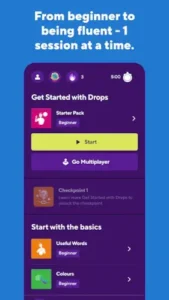
You can begin without spending anything. The Starter Pack and beginner words like Colours and Useful Words are open from minute one. If you want checkpoint unlocks and multiplayer access, those sit behind a subscription. But you will know whether the format works for you long before you need to pay. For the full experience, Download Drops from the Official Play Store
How is this different from staring at flashcards for twenty minutes?
Flashcards test memory. Drops builds rhythm. Each session runs on a timer, so you stop before your brain switches off. That is not a gimmick. That is how adults actually retain vocabulary. You can read more on the official website here: Official Drops Website
I saw 4.7 stars and App of the Year. Does that actually mean anything?
It means people finish sessions. Not just download and forget. A 4.7 rating on Google Play with over two million English learners alone suggests the app solves the real problem: starting and staying. For the full history and company background, check the wiki page here: Drops Wiki
What if I run into a bug or have a question about my account?
You contact the people who build it. For technical support or account help, write directly to the developer email address: android[at]languagedrops.com. Do not sit there frustrated. They answer.
Can I really go from beginner to fluent using only this app?
Fluent? No single app gets you there. But Drops gets you past the boring part. The part where most people quit. From there, you speak with real people. The app handles vocabulary and visual memory. You handle conversation.