
Tripadvisor exists to solve a lot of trip problems.

The process of planning a trip without Tripadvisor can often feel paralyzing. You face an endless stream of options for hotels, restaurants, and activities, scattered across countless websites and apps, each claiming to be the best. This information overload makes confident decision making difficult. It functions as a centralized hub for crowd sourced travel intelligence, aggregating millions of reviews and opinions into a single, searchable platform designed to simplify the entire planning process.
Defining the Tripadvisor Ecosystem
It is crucial to understand what Tripadvisor is not. It is not a direct service provider like a hotel chain or a tour operator. Instead, it operates as a metasearch and review platform. Its core purpose is to aggregate information, prices, and availability from countless other companies, presenting it all in a standardized, comparable format. It is the intermediary that helps you research and then connects you to the provider for booking.
The platform’s most defining feature is its sheer scale and scope. Tripadvisor hosts a massive database comprising hundreds of millions of reviews, photos, and listings for hotels, restaurants, attractions, and tours worldwide. This volume establishes it as the largest travel guidance platform on the planet, offering a depth of information that is nearly impossible to find elsewhere. This makes it an essential first step for checking Tripadvisor hotel reviews and comparing Tripadvisor vacation rental ratings.
The key differentiator that fuels this scale is its foundational reliance on user generated content. Tripadvisor’s model creates a self sustaining cycle: travelers use the site to plan their trips, and then return to contribute their own reviews and photos, which in turn help the next wave of travelers. This cycle builds both immense volume and a degree of trust, as reviews come from verified users who have actually visited the places they describe.
Tripadvisor User Workflow: From Inspiration to Booking
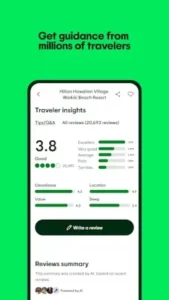
The user experience typically begins with the research phase. Whether you have a destination in mind or are just looking for ideas, you can search for a city or activity and be presented with a ranked list of options. The ability to read thousands of verified reviews, compare user generated photos against professional shots, and use detailed filters (like “families” or “couples”) is invaluable for narrowing down choices and managing expectations.
This research naturally flows into the planning phase. The app allows you to save interesting finds to lists or use its itinerary organizer to build a day by day plan for your trip. AI powered recommendations can suggest activities or dining options based on your saved places and search history, serving as a useful tool for overcoming planning fatigue and discovering hidden gems you might have otherwise missed.
Finally, the platform facilitates the booking phase. Once you decide on a hotel, tour, or restaurant, Tripadvisor provides a seamless transition from research to action. It links directly to partner sites like Booking.com or Expedia to complete the reservation. This integrated process is where users can often earn Trip Cash rewards, a financial incentive that discounts future travel bookings made through the platform.
Tripadvisor Core Value
The primary value proposition is the wisdom of the crowd. Access to millions of real world experiences provides a transparency that was previously impossible for travelers. Reading a mix of positive and critical reviews offers a much more realistic view of what to expect than any marketing description ever could.
A secondary, but equally important, value is consolidation and convenience. Tripadvisor provides a single starting point for researching every aspect of a trip. Instead of juggling a dozen tabs for hotels, another dozen for restaurants, and more for activities, you can conduct nearly all your initial research within one ecosystem.
The financial incentive of the Trip Cash rewards program adds tangible value, effectively functioning as a discount on future travel for users who book through the platform. Furthermore, the integrated planning tools, particularly the itinerary builder, offer practical utility by keeping all confirmations, reservations, and saved ideas in one easily accessible place, reducing pre trip organizational stress.
The app holds a 4.8 star rating from over 1.4 million reviews, is rated for teens, and has a download size of approximately 100 MB. For travelers focused primarily on hotel bookings, Booking.com is a similar app that offers a more streamlined reservation process.
Tripadvisor Practical Considerations
Users should maintain a critical eye regarding review authenticity and bias. While Tripadvisor has systems to detect fake reviews, no system is perfect. It is also wise to remember that people who have extremely positive or negative experiences are more likely to post a review than those with an average experience, which can sometimes skew perceptions.
Another consideration is interface evolution. The platform frequently updates its design and features. Some long time users find these changes initially disruptive, though they often represent improvements and modernizations over the long term.
Perhaps the most important practical note is that Tripadvisor is a platform, not a provider. While it is excellent for research and price comparison, any customer service issues, changes, or cancellations for a booked service must be handled directly with the third party company you booked with (e.g., Booking.com, Viator), not with Tripadvisor itself. Understanding this distinction is key to managing expectations after clicking the “book” button.
Understanding Tripadvisor’s Role in Your Travel Toolkit
Choosing the right digital tools for travel planning requires understanding their distinct purposes. Each platform excels in a specific area, and knowing where Tripadvisor fits helps you use it for its strengths and avoid its limitations, ensuring a more efficient and effective planning process.
Tripadvisor’s Position in the Market
To grasp Tripadvisor’s value, it’s useful to compare it to other platforms, often categorized as Tripadvisor similar apps. Each serves a different primary function. Booking.com is a powerful transaction engine focused primarily on direct hotel bookings. Its interface is designed for speed and efficiency in securing a room, but its review system is generally less detailed and extensive than Tripadvisor’s dedicated community.
Yelp operates in a similar space but with a different focus. It excels at hyper-local business reviews, particularly for restaurants and services in specific neighborhoods, often within your own city. Tripadvisor’s scope is explicitly and exclusively travel focused, with a global rather than local viewpoint, offering curated lists and reviews for destinations worldwide.
Google Travel represents a more algorithmic approach. It leverages user data and powerful search to suggest options and streamline the booking process for flights and hotels. Tripadvisor’s advantage is its human centric, community driven content. It offers the nuanced, qualitative feedback of millions of travelers, which can often provide a more relatable and detailed perspective than an algorithm.
Tripadvisor’s position is that of the broadest aggregator of travel specific reviews. Its unparalleled strength lies in the inspiration and research phase of travel planning. It is the best first step for answering questions like “What are the best things to do in Rome?” or “Which hotel in Bangkok has the best pool for families?” before you ever visit a booking site. This is a crucial Tripadvisor tip: use it to discover and vet options, then compare final prices on booking platforms.
This functionality defines its ideal user profile. Tripadvisor is most valuable for a specific type of traveler. The first is the researcher, the person who heavily relies on reviews and photos from fellow travelers to manage expectations and avoid disappointing experiences. The second is the complex trip planner organizing a journey with multiple components, flights, hotels, tours, and restaurants, who benefits from having a single repository for all their research. Finally, it appeals to the reward seeker who appreciates earning Trip Cash on their travel spending for future savings.
Conclusion :
The core strength of Tripadvisor remains unchallenged: it is the most comprehensive source of travel reviews and crowd-sourced insights on the planet. Its powerful role in the initial discovery and research stages of travel planning is virtually unmatched. For gauging the real-world experience of a hotel or the actual atmosphere of a tour, there is no better resource.
The most balanced perspective is that its value is greatest as a research and planning aid rather than a flawless, end-to-end booking engine. Its primary utility is in informing your decisions, not necessarily in being the final point of sale. While its booking features are convenient and linked to rewards, many travelers still prefer to complete their transactions on specialized platforms for hotels, flights, or tours after using Tripadvisor for discovery.
Therefore, the parting recommendation is to position Tripadvisor as an essential, first-step tool for nearly any traveler. It is the modern replacement for the traditional travel guidebook, but with a critical advantage: real-time, crowd sourced updates. Its value is not in completing the transaction, but in ensuring you make a transaction you feel confident about. The most practical Tripadvisor booking tip is to use the reviews to create a shortlist of your top three hotels or tours, then open those specific options in a dedicated booking engine or the provider’s own website to check for any exclusive offers or better rates before you finalize your plans.
Used this way, as the foundation of your research, it becomes an indispensable part of crafting a trip that truly aligns with your expectations.
FAQ
How does Tripadvisor’s Trip Cash rewards program work?
Tripadvisor offers a rewards program called Trip Cash where you earn credits on eligible bookings made through their platform. You typically earn a percentage back (often around 5-10%) which can be applied toward future travel bookings. The terms and eligible bookings can be reviewed on their Tripadvisor official website.
What is the process for a Tripadvisor download and is the app free?
The Tripadvisor app is completely free to download and install from the Google Play Store. The company generates revenue from travel bookings and partnerships, not the app itself. For technical support with the application, you can contact the development team at mobilehelp[at]tripadvisor.com.
Can I trust Tripadvisor reviews to be authentic and unbiased?
Tripadvisor has verification systems and moderation to maintain review authenticity, but users should exercise critical thinking. Look for reviews that provide specific details and photos, and consider the overall consensus rather than individual extreme opinions. For historical context and company information, you can refer to its Tripadvisor Wiki page.
How does Tripadvisor make money if the app is free?
Tripadvisor operates as a metasearch platform, earning commission from booking partners when users complete reservations through their links. They also offer advertising opportunities to businesses and premium subscription services, which allows them to maintain free access for most users.
What should I do if I need to change or cancel a booking made through Tripadvisor?
Since Tripadvisor connects you to booking partners, any changes or cancellations must be handled directly with the service provider (hotel, tour company, etc.). Your confirmation email will contain the appropriate contact information. Tripadvisor’s customer support can help facilitate communication if needed.