Grok enters a market saturated with AI tools that often feel like transactional query machines.
You ask, it answers. The exchange is sterile, predictable, and ultimately, forgettable. But what if an AI didn’t just process your request; it engaged with your intent, adding color and context to the conversation? Developed by Meta’s xAI, Grok is engineered to merge formidable computational power with a distinct, witty personality and a direct line to the real time web. This combination positions it not as another tool, but as a collaborative intelligence. It aims to be a partner in your curiosity, not just a repository for it.
Defining the Grok Vibe: Personality as a Core Function
The first thing you notice with Grok isn’t its accuracy, but its tone. Its “sharp, witty” character is not an accidental byproduct; it’s a deliberate design choice. In a landscape of uniformly neutral digital assistants, Grok’s willingness to offer a satirical remark or frame an answer with humor is a strategic feature. This approach raises a fundamental question: does personality hinder utility, or can it actually enhance comprehension and retention? The design philosophy behind Grok suggests the latter. It is built for sustained engagement, transforming the user experience from simple information extraction to a dynamic dialogue.
For users researching how Grok AI compares to ChatGPT for creative writing, the personality is often the deciding factor, making the process feel less like issuing commands and more like batting ideas back and forth with a knowledgeable colleague.
The Engine Room: How Grok Processes a Live World
Beneath the engaging exterior lies a sophisticated architecture built for relevance. Its most significant technical advantage is real time access to the data stream from X (formerly Twitter) and the open web. While other AIs operate on static, pre existing datasets, Grok can analyze emerging trends, breaking news, and live public sentiment. This capability is what makes its answers feel current and context-aware, not just correct in a historical vacuum.
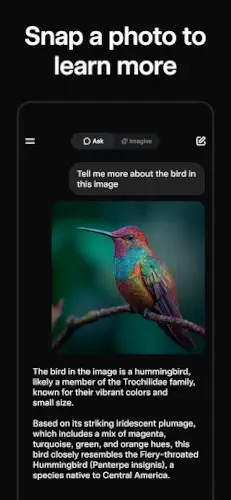
To manage different types of queries, Grok employs specialized modes. Think of DeepSearch as its methodical research librarian, ideal for complex academic or professional queries requiring detailed data synthesis. The Big Brain mode, conversely, is for tackling intricate problem solving and conceptual analysis. Furthermore, its multimodal input, accepting text, voice, and images, acknowledges that information comes in many forms. The ability to upload a document for instant analysis or a photo for explanation makes it a versatile perceptual tool, not just a textual one.
This is crucial for anyone evaluating the practical benefits of Grok AI for data analysis, where speed and multiple input methods directly impact productivity.
Is Grok A Toolbox for Practical and Creative Problem Solving
Grok’s features are designed for application, not just observation. Its ability to generate images, videos, and animations via text or voice prompts moves it beyond a conversational novelty into a utility for prototyping and content creation. This function serves as a brainstorming partner that can produce tangible assets, whether for a marketing concept or a personal project.
This flexibility extends to its interaction model. The customizable assistant personas, switching from a formal Assistant mode for professional emails to a casual Storyteller mode for creative ideation, allow the user to tailor the tool’s voice to the task’s context. Similarly, the fully featured Voice Mode is a nod to practical utility, enabling true hands free operation. This isn’t just about convenience; it’s about accessibility and integrating AI assistance into moments when your hands or eyes are occupied elsewhere, fundamentally changing the rhythm of your workflow.
Measuring Grok in the Wild
User feedback paints a picture of a platform that is both impressive and evolving. The overwhelming positive sentiment centers on its engaging, context-aware, and often humorous interactions. Users frequently report that Grok’s responses feel less generic and more thoughtfully constructed than those from other assistants, especially for open-ended or complex queries.
However, this advanced functionality comes with technical trade offs. Critical reviews consistently point to significant battery drain on mobile devices, occasional app glitches, and the inherent challenges of content moderation for an AI with such a free-flowing style. Some users report inconsistencies with voice input stability. It is essential to frame these not as permanent flaws, but as the realistic growing pains of a computationally intensive and rapidly evolving platform.
The high user satisfaction scores, often reflected in a strong average rating of 4.5 stars from over 500,000 reviews for an app of its size (approx. 150MB), indicate that for many, the core value proposition outweighs the current technical friction. Its appeal spans a broad age range, primarily attracting users from young adults to professionals (18-45) who value both substance and style.
For those considering the landscape of AI assistants, it’s useful to look at alternatives that focus on different strengths. A noteworthy option is ChatGPT, which remains a premier tool for focused, text based assistance and structured tasks. You can find more about it and similar applications on comprehensive directories like Free Apps Android.
Navigating the AI Landscape: Where Grok Fits In
To understand Grok’s value, you need to see it not in isolation, but in conversation with the tools around it. The field of large language models is no longer a monolith; it’s a spectrum of specialized instruments. So, where does this particular AI find its footing?
The most frequent comparison is with ChatGPT. The distinction here is foundational. ChatGPT often operates as a brilliant, general-purpose scholar with a vast but static library. Its strength is coherence, structure, and depth on established topics. Grok, in contrast, is like a well-connected analyst in a bustling newsroom. Its integration with the X platform provides a palpable edge for queries that demand timeliness. Asking “what are the key takeaways from the latest tech keynote?” will yield a rehearsed summary from one, and a synthesis peppered with live reactions and emerging commentary from the other.
This makes using Grok for real time market analysis a fundamentally different experience, one grounded in the immediacy of the current moment rather than the curated knowledge of the past.
Beyond this primary rival, the comparison shifts to breadth versus depth. Specialized applications exist for nearly every function Grok offers. There are superior standalone image generators, more focused coding assistants, and research tools with deeper academic databases. Grok’s proposition isn’t about being the absolute best in any single vertical, but about being remarkably competent across many of them. Its unique signature is the fusion of three elements: a defined personality, a live data stream, and broad creative utility.
This blend is what defines its niche. For users tired of managing multiple specialized subscriptions and interfaces, the appeal of a capable all in one collaborator with a consistent voice is strong. This is the core answer for anyone weighing Grok alternatives for content creators who need both factual accuracy and a spark of creative flair in a single workflow.

Sharpening Your Approach: Practical Grok Tips
To move beyond basic queries and unlock its potential, your strategy matters. The first of our essential Grok tips is to master the art of the prompt. Because of its conversational design, you can layer context. Instead of “write a product description,” try “act as a skeptical product reviewer and write a critical description for this new smartwatch, then switch to a marketing persona and write a persuasive counterpoint.” This leverages its personality modes dynamically.
Second, actively use Grok as a brainstorming partner that can produce assets. When stuck on a visual concept, use the image generation not for a final product, but for rapid prototyping. A prompt like “generate three abstract logo concepts for a fintech company called ‘Nexus’ that conveys security and innovation” can break creative block instantly. This approach transforms it from a chat interface into an interactive idea engine.
Third, do not overlook the document and image analysis for practical tasks. A powerful application is how to use Grok for research paper summarization. Upload a dense academic PDF and ask it not just to summarize, but to “extract the main hypothesis, list the supporting evidence, and identify any limitations mentioned by the authors.” This structured approach yields far more useful results than a simple recap. For daily tasks, use the voice mode to dictate a messy stream of consciousness for a blog post or email, then command it to “structure these thoughts into a coherent draft with a clear subject line.” This hands free method captures your raw ideas without the friction of self editing while you type.
Conclusion :
Grok’s lasting value lies in its synthesis. It demonstrates that raw informational power and a collaborative, personable interface are not mutually exclusive ideals. It has successfully made the interaction with a vast language model feel less like querying a database and more like a dialogue with a well informed, quick witted colleague.
However, it is crucial to position Grok not as a finished product, but as a significant and telling prototype for the future of AI interaction. Its technical demands and occasional inconsistencies are reminders of the immense computational complexity required to make a system this responsive and current work seamlessly. Its evolution will be a key indicator of the industry’s direction. The question it leaves us with is not about its current feature set, but about the nature of the tools we want to use.
Do we prefer our intelligence sterile and flawless, or engaging and adaptable, even if it sometimes shows its seams? Grok firmly bets on the latter, making its ongoing development a compelling narrative to watch, as it refines its role as a genuine partner in the process of inquiry and creation.
Frequently Asked Questions
Is there a separate Grok download, or is it part of another app?
Grok is a standalone mobile application. You can find and install it directly from the official app stores. There is no need to download a separate platform to access it.
What is the most practical use for the Snap a photo to learn more feature?
Think of it as having a visual search engine. It’s for moments of immediate curiosity: identifying a plant in your garden, understanding the components of a complex diagram in a textbook, or getting information about a landmark you’re visiting. It turns your camera into a tool for instant learning.
Can I use Grok to create video content from text prompts?
Yes. The “Imagine” feature, as shown in the app interface, allows you to generate short video clips based on detailed text descriptions. This is useful for creating quick storyboards, conceptual visuals for presentations, or exploring creative ideas for social media content without needing production equipment.
How does Grok’s real time data access impact its accuracy?
This is its core advantage and a key limitation. It provides incredibly current information, pulling from live sources, which makes it excellent for trends and news. However, this also means its answers can reflect the real-time inaccuracies or biases present in those sources, so corroborating critical information is always a sound practice.
Who should I contact for technical support or to provide feedback?
For general user support and troubleshooting, the help section within the Grok app or on the official website is the best first step. For specific developer related inquiries or to report a technical bug, you can use the dedicated developer contact channel.
-
Official Website: https://grok.com/ (grok official site)
-
Play Store Link: https://play.google.com/store/apps/details?id=ai.x.grok
-
Grok Wiki: https://en.wikipedia.org/wiki/Grok_(AI)
- Developer Inquiries: support[at]x.ai