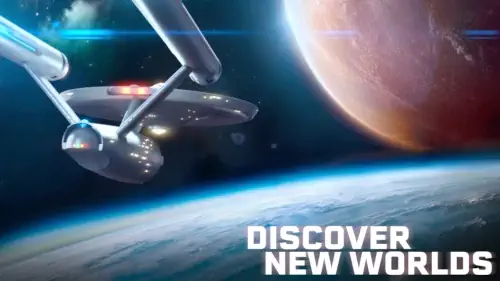
Star Trek Fleet Command presents a fundamental question for any aspiring captain: how do you establish a foothold in a galaxy filled with ancient rivalries and uncharted dangers?
Star Trek Fleet Command MMO strategy game from Scopely addresses this by merging starbase management with fleet command and interstellar diplomacy. It is a experience where your resource decisions directly impact your ability to explore strange new worlds. For new players, understanding the principles of a Star Trek Fleet Command beginner guide and effective Star Trek Fleet Command resource management is crucial for early survival. Currently, the game holds a rating of approximately 4.2 stars from over 1 million reviews, with a download size around 500MB and a Teen rating.
Star Trek Fleet Command Concept and Setting
The game unfolds in a persistent online galaxy where the Federation, Klingons, and Romulans vie for influence. The core loop follows the established 4X model: you Explore new star systems, Expand your influence, Exploit resources from planets and asteroids, and Exterminate hostile forces. This entire process is supported by three interconnected pillars: developing your starbase, progressing your roster of officers and ships, and engaging in alliance centric warfare. Your success depends on maintaining progress across all three fronts in a dynamically shifting political landscape.
Your Starbase: The Heart of Operations
Your starbase is the logistical core of your interstellar operations. Constructing and upgrading buildings like mines, research labs, and shipyards is a continuous process that fuels your expansion. Resources like tritanium, dilithium, and parsteel are the lifeblood of your fleet, required for everything from constructing new vessels to researching advanced technologies. A common strategic error is prioritizing warship construction over economic infrastructure. Can your resource production support the repair costs of a major fleet engagement or a rapid technological leap? A robust and diversified economic foundation is your best defense against stagnation and rival incursions.
Crew and Vessels: Officers and Fleet Management
Recruiting and Developing Iconic Officers
The officer system brings the Star Trek universe to life, allowing you to recruit and command legendary characters like Kirk, Spock, and Data. Acquiring an officer is just the first step. Each one levels up, promotes through tiered ranks, and possesses unique active and passive abilities that can be synergized with other crew members. This deep progression means your choice of which officers to develop and how to compose your bridge crew for different missions is a primary strategic consideration, directly impacting your effectiveness in both Star Trek Fleet Command officer tier list rankings and actual combat performance.
Building and Commanding Your Fleet
Military success hinges on operating a versatile fleet. The game features multiple ship classes, from agile interceptors to powerful battleships, each with specific roles and counter relationships. Deploying a survey ship to mine a contested system is an invitation for attack, while sending a battleship against a swarm of interceptors can be inefficient. Understanding these dynamics and building a balanced fleet capable of handling different threats is a fundamental skill for any captain.
The Diplomacy of Force: Conflict and Cooperation
Engaging in PvP and Territory Control
The struggle for territorial control is a constant throughout the galaxy. The game features real-time PvP where you can engage rival players’ fleets and participate in large-scale alliance wars for control of entire star systems. These are not isolated skirmishes but persistent conflicts that demand strategic coordination, shared intelligence, and precise timing with your alliance members. Control over these systems grants substantial bonuses, making this competitive sphere the primary endgame for dedicated players.
Exploring PvE and Narrative Missions
For those focused on exploration or gathering resources, the game offers extensive PvE content. Story-driven missions advance narratives inspired by various Star Trek series, while daily goals and limited-time events provide the essential materials, blueprints, and officer shards needed for progression. These activities serve as both a reliable path for growth and a lower-risk environment to test new fleet compositions.
The Alliance: Social Structures and Community
Operating alone in this galaxy is a significant liability. Alliances are the social and strategic backbone of the experience, offering a protective network, resource assistance, and access to exclusive group content. The in game chat system is vital for the real time coordination these large scale operations require. This community extends massively to platforms like Discord, where players organize and refine their strategies. For a different style of space strategy with a deeper focus on player-driven economy, you might also consider EVE Echoes.
Visual Presentation and Technical Performance
The game employs detailed 3D graphics that faithfully recreate iconic starships and celestial phenomena. The user interface is necessarily dense, packing a tremendous amount of strategic information into a mobile format, which has a learning curve but provides comprehensive control. It is important to note that some players report performance variations, including occasional lag during major fleet engagements or stability issues on some devices, which can impact the experience during critical moments.
The Captain’s Log: Strengths and Considerations
The Core Appeal
The game’s lasting power stems from its authentic integration of Star Trek lore, which provides meaningful context for every decision. The strategic fleet combat system requires genuine tactical thinking about ship roles and officer abilities rather than simple power level comparisons. This depth, combined with deeply integrated alliance systems, creates a socially dynamic environment where coordination with other players becomes essential for controlling territory and tackling the galaxy’s greatest challenges.
Points of Friction
Player feedback consistently highlights the game’s progression curve, where upgrade times and resource requirements can increase substantially at higher levels. This pacing can create noticeable grinding periods, particularly for free to play captains. Some players also report that technical performance can vary, with occasional lag during large scale fleet engagements affecting the experience.
Command Protocols: Strategies
Securing Your Resource Infrastructure
Your starbase’s long term viability depends on its economic foundations. Before committing to expensive warship projects, ensure your mining and research operations are consistently upgraded. A strong resource base allows you to recover from combat losses and maintain technological advancement, forming the cornerstone of any effective Star Trek Fleet Command progression guide.
Building a Versatile Fleet and Crew
A successful command relies on having the right tools for different situations. Instead of focusing on a single powerful ship, develop a balanced fleet with specialized vessels for combat, mining, and research. Similarly, concentrate on developing a core team of officers whose abilities complement each other. This approach to your Star Trek Fleet Command best ship build and crew composition proves more effective than maintaining a single specialized setup.
The Imperative of an Active Alliance
In this galaxy, isolation creates vulnerability. A strategic alliance provides defensive coverage, resource assistance, and access to exclusive group content with superior rewards. When evaluating an alliance, prioritize those with organized leadership and clear communication channels. For additional support, checking for active Star Trek Fleet Command codes can provide free resources, speed-ups, or research boosts to supplement your operations.
Managing Your Strategic Assets
Speed up items and premium currency are limited resources that require careful allocation. Use your Latinum for permanent upgrades or highly valuable items from special events rather than accelerating routine tasks. Focus your spending on investments that provide long term strategic advantages to ensure steady advancement through the officer ranks and ship tiers.
Star Trek Fleet Command Similar Games
For commanders considering their options, several Star Trek Fleet Command alternative games offer different approaches to space strategy. EVE Echoes provides a much deeper, player driven economy and sandbox universe with complex manufacturing and market systems. Star Wars: Galaxy of Heroes focuses primarily on character collection and turn based squad combat rather than fleet management and territory control. Hades’ Star offers a similar blend of exploration and corporation warfare but with a distinct visual style and different combat mechanics.
Conclusion :
Star Trek Fleet Command establishes its position as a lore-rich strategy title that successfully combines authentic Star Trek elements with deep base building and fleet management systems. Its appeal is balanced against a progression model that requires strategic patience and can involve significant resource investment, particularly in the later stages.
The ideal captain for this bridge is a player genuinely invested in the Star Trek universe, who finds satisfaction in long-term strategic planning and fleet composition, and who values the collaborative, competitive nature of a dedicated alliance. If you prefer solitary play or a faster-paced, less socially demanding experience, this might not be your vessel. But if you are prepared to build your legacy through careful resource management and coordinated interstellar diplomacy, space awaits your command.
Frequently Asked Questions (FAQ)
What type of game is Star Trek Fleet Command?
It’s a space strategy MMO where you build a starbase, command iconic starships, recruit famous officers, and engage in territorial conflicts within the Star Trek universe through exploration and alliance warfare.
How important are alliances in gameplay?
Alliances are fundamental to progression, providing protection from attacks, enabling coordinated territory control, and offering access to exclusive group content that’s impossible to complete alone.
Where can I find Star Trek Fleet Command download options?
The game is available on both Android and iOS mobile platforms through their respective app stores. You can download Star Trek Fleet Command directly from the Google Play Store.
What’s the best approach for new players starting their command?
Focus on upgrading resource operations first, join an active alliance immediately, and concentrate on building a balanced fleet with specialized ships rather than focusing on a single vessel type.
Who develops Star Trek Fleet Command and how do I contact support?
The game is developed by Scopely. For technical support or account assistance, you can contact their customer service team at the following email address startrek-support[at]scopely.io