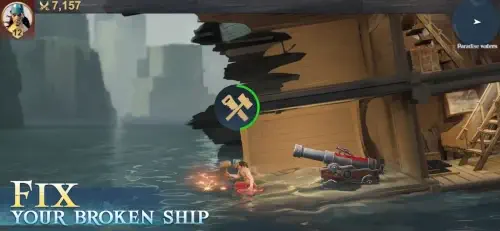
Tides of Conquest positions itself at the intersection of several genres, attempting a blend that is both ambitious and specific.
What separates a memorable naval game like Tides of Conquest from a forgettable one? The answer often lies not in a single feature, but in the fusion of its parts.. The core proposition is a hybrid model. This is not just a base building game with naval skins, nor is it a pure action combat title. It is a attempt to marry the deliberate, long term planning of port management with the immediate, kinetic demands of real time naval warfare.
You are simultaneously a mayor and an admiral, tasks that often pull your attention in opposing directions. This creates a compelling tension. Do you invest resources in your harbor’s economic infrastructure, or pour all available lumber and gold into reinforcing your flagship’s hull for the next battle? This fundamental trade off is the central economic puzzle of the game.
Visually, the game makes a strong first impression. The 3D maritime aesthetic is rich, with water physics that convincingly sell the feeling of a heavy vessel cutting through swells. Ship models are detailed, and port cities are bustling with visual activity. However, this graphical fidelity introduces a significant question: does the visual presentation enhance immersion or contribute to a cluttered feel?
The UI, while thematically appropriate with its weathered maps and nautical icons, can become a dense forest of buttons and notifications during peak activity. This is a common challenge for complex mobile strategy games, and Tides of Conquest does not entirely avoid it. The very detail that makes the world feel alive can sometimes obscure the critical information you need to command it effectively.
The primary gameplay loop is a familiar yet potent cycle: sail, battle, manage, upgrade. You embark from your port to complete missions, engage adversaries for loot, and discover new trade routes. Returning to your harbor triggers the management phase, where you allocate gathered resources to construct new buildings, research technologies, and repair your fleet. Then, it is back to the sea. The loop’s success hinges on the tangible sense of progression.
Does upgrading your frigate’s cannon from Level 4 to Level 5 feel impactful in the next skirmish? In this game, it typically does, creating a satisfying feedback of effort to reward that fuels the desire for just one more voyage. For those comparing their options, this strategic depth offers a different flavor from the more straightforward action found in a game like Modern Warships, which focuses almost exclusively on naval combat.
Tides of Conquest Mechanics: Your Ship and Crew
Beyond the initial spectacle, the true test of any strategy game is the depth of its systems. How much actual command do you wield over your destiny? In Tides of Conquest, this authority is tested through your flagship, your crew, and your battle tactics.
Flagship customization is a cornerstone of the progression system. This goes beyond simple cosmetic changes. The choices you make in arming your vessel are critically strategic. Do you outfit it with long range mortars to engage enemies from a safe distance, or do you favor shorter range, high rate of fire cannons for brawling? Armor placement, sail quality, and auxiliary equipment all present meaningful trade offs that directly shape your role in a fleet engagement. Your flagship is not just a sprite; it is a reflection of your strategic personality.
Furthermore, crew assembly is far more than a simple stat boosting menu. Recruiting a master gunner might decrease your reload times, while a seasoned navigator could increase your fleet’s overall movement speed on the strategic map. These are not passive bonuses. They actively influence how you approach both exploration and combat. Do you build a crew optimized for plundering trade routes quickly, or one designed to maximize damage output in the scheduled guild battles? This system adds a vital layer of personalization and long term planning, making your fleet feel uniquely yours.
The real time fleet command then brings these preparations to life, demanding you manage formations and target priorities amidst the chaos of battle.
The Tides of Conquest World: Sailing the Devil’s Seas
A vast map means very little if every island offers the same palm tree. The true measure of a game world is not its scale, but the diversity of experiences it contains. For players seeking the best Tides of Conquest similar games or a guide on how to get more gems in Tides of Conquest, understanding this virtual geography is the first step.
Exploration in the Devil’s Seas presents a mixed cargo. The initial hours feel expansive, with new ports unlocking different mission types, from straightforward cargo deliveries to multi stage bounty hunts. Hidden treasure maps and random encounters provide sporadic moments of discovery that break up the routine. However, the core loop of sailing from point A to point B can, over time, begin to show its repetitive skeleton. The question of vastness versus repetition is answered by your tolerance for the core gameplay; if the act of sailing and managing your fleet remains compelling, the world feels alive. If not, the voyages can start to feel like a lengthy loading screen between objectives.
The social seas, particularly the alliance system, are not a peripheral feature but a central pillar of the mid to late game. Forming a cohesive group is less an optional social activity and more a strategic necessity. The tangible benefits are too significant to ignore. Alliances provide secure trade routes with better exchange rates, enable cooperative defense of valuable territories, and unlock exclusive alliance only missions with superior rewards. This is where the game transitions from a solo campaign to a persistent, social strategy experience. For anyone looking up Tides of Conquest tips, the unanimous advice will be to find an active guild early.
Cyclical events like the Heroic Trials and the Showdown o’Gangs form the backbone of the endgame. These are not mere distractions; they are the primary source for the rare blueprints and resources needed for top tier upgrades. Do they offer lasting engagement? They do, but with a caveat. Their appeal is directly tied to a player’s competitive drive and their alliance’s activity level. For a dedicated group, these events are a weekly proving ground that renews purpose. For a solo player, they can feel like an insurmountable grind against organized factions.
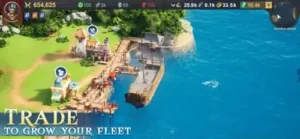
Tides of Conquest Tips
Knowing the winds is more important than just having a strong ship. For those searching for active Tides of Conquest codes or a reliable Tides of Conquest guide, these strategic bearings can streamline your journey.
Your early game priorities should be ruthlessly economic. Do not pour all your initial resources into offensive upgrades. Instead, focus on upgrading your port’s resource generating buildings and unlocking additional trade slots. A strong economic base will fund your warships far more effectively than any single early victory. Prioritize upgrading your flagship’s durability and cargo hold; survival and resource capacity are your primary constraints in the beginning.
The mid game transition is where the alliance tip becomes a mandate. An active alliance is not just for company; it is a fundamental power multiplier. The resource bonuses, shared defensive structures, and coordinated attack capabilities are designed into the game’s balance. Trying to progress past a certain point without a solid alliance is like trying to sail against a hurricane with a single sail.
Endgame optimization is about strategic focus. You cannot excel in every event. Analyze your fleet’s strengths and your alliance’s goals. Dedicate your resources to excelling in one or two cyclical events that offer the rewards most relevant to your chosen playstyle. Specializing is more effective than being a generalist. Maximize your resource return by focusing on events where your specific ship loadout and crew composition provide a competitive edge.