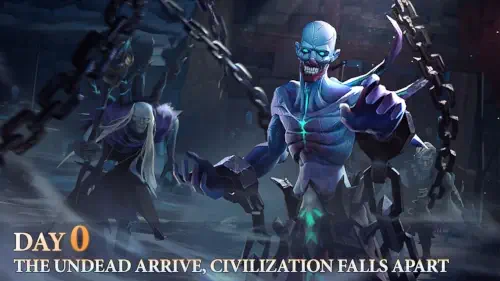
Dusk of Dragons: Survivors asks a simple question: what if your most powerful tool against a zombie apocalypse wasn’t a fortified wall or a sharpened sword, but a dragon you raised from an egg?
Dusk of Dragons: Survivors blends the tense resource management of a shelter builder with the companionship of a monster tamer and the frantic action of tower defense. But does this combination create a cohesive and fresh experience, or does it buckle under the weight of its own ambition, getting lost in a maze of complex systems? To answer that, we need to look past the icy spectacle and see what you’re actually doing in this frozen wasteland.
What Is Dusk of Dragons: Survivors, Really?
Calling it a “zombie survival game” is technically correct but misses the point. Dusk of Dragons: Survivors is better understood as a shelter management simulator with three core, interconnected layers. The first is the classic survival loop: build, gather, defend. The second is a dragon companion system that functions as both a combat unit and a logistical tool. The third is a wave based defense strategy game that tests your preparation every night.
This hybrid design positions it uniquely in the mobile survival niche. It’s not just about scraping by; it’s about building a functioning economy to support a mythical war beast, which in turn secures your future. The dragon isn’t a late game reward or a cosmetic pet, it’s a central, game changing mechanic you engage with from the early hours. Understanding this three part structure is key to navigating what comes next.
Dusk of Dragons: Survivors Features: Building, Bonding, and Surviving
The features aren’t a checklist; they’re interlocking cogs in a survival machine. Ignore one, and the whole system grinds to a halt.
Your Fortress in the Frost (Shelter & Automation)
Your journey starts with a ruin. Building it into a haven involves constructing workshops for crafting, farms for sustainable food, and defensive towers. The crucial layer here is automation through Squires. These rescued survivors can be assigned tasks based on their skills, some are better gatherers, others fighters. Assigning them effectively to facilities is your first major management challenge, turning your base from a static collection of buildings into a minimally self sustaining operation. This is the foundational work that fuels everything else.
The Ultimate Ally (Dragon Summoning & Care)
This is the game’s unique proposition. You don’t just find a dragon; you hatch and raise one. This involves building and upgrading a Dragon Nest, a resource-intensive structure that acts as its home. Your dragon is more than a flying flamethrower. Different types offer unique abilities, from direct combat to healing, and critically, they can carry a massive amount of loot. This transforms them from a simple weapon into your most valuable logistical asset for risky expeditions. Raising a dragon is a significant, ongoing investment, making it a true companion rather than a disposable tool.
The Endless Night (Zombie Defense & Combat)
The day is for preparation, the night for execution. When darkness falls, waves of undead assault your shelter. Your crafted weapons and armor equip you for manual fighting, while strategically placed sentry towers provide automated support. The quality of your defense is a direct report card on your day’s work in resource gathering, crafting, and base layout. Bosses and mutant zombies add chaotic variables, ensuring you can’t simply hide behind walls.
Venturing Into the Grey (Exploration & Instances)
Beyond your camp lie fog shrouded instances, high risk zones filled with resources, survivors to rescue, and greater threats. Entering these areas requires planning. Your dragon’s combat strength and carry capacity become paramount. Is your gear good enough to handle the creatures inside? These trips are the primary way to secure rare materials and expand your community, but overextending can mean losing everything you gathered.
Dusk of Dragons: Survivors Visuals, Flow, and Friction
Atmosphere and Presentation
The game succeeds in setting a distinct mood. The stylized 3D visuals render the snowy ruins with a stark beauty, and dynamic effects like swirling blizzards or the ominous glow of a horde at night are immersive. Dragon models are detailed, and their animations in combat feel impactful. The UI for base management is generally clean, making the complex web of structures and assignments somewhat navigable. For a mobile title, it builds a convincing medieval apocalypse.
The Learning Curve and Community Gap
This is where the experience fractures for many players, according to widespread feedback. The sheer complexity of items, resources, and upgrade paths is overwhelming, and with no in-game wiki, players are left to experiment or seek answers externally. The public chat is often described as inactive, creating a sense of isolation for new survivors. Furthermore, the monetization model, particularly around limited time events and random chance mechanics, can create a tangible sense that progression is gated behind payment.
Dusk of Dragons: Survivors Tips for New Survivors
Knowing the pain points is half the battle. Here’s how to navigate them:
-
Priority One: Secure a basic Dragon Nest early. Your dragon accelerates every other aspect of the game.
-
Assign Squires by Stat: Don’t just assign anyone anywhere. Check a squire’s stats and place them in roles that match their strengths (e.g., high gathering stat for farms).
-
Dragon as a Pack Mule: When exploring instances, use your dragon’s carry capacity to haul back massive amounts of resources. This is their most underrated early-game utility.
-
Find an Alliance Externally: The in-game tools for finding active groups are weak. Use the official Dusk of Dragons: Survivors Discord or Telegram channels (links are in the game’s community info) to find a helpful guild. This is almost mandatory for late-game content and advice.
-
Basic Survival Logic: Always cook farmed food before eating; it provides more energy. In instances, if your health is low and your potions are gone, retreat. Losing gathered loot is better than losing your equipped gear.
*(At the time of writing, Dusk of Dragons: Survivors holds a 4.5 star rating from over 500,000 reviews on the Play Store. The app size is approximately 1.2GB, and its content is geared toward teens and adults due to its survival horror themes and strategic complexity.)*
For players who enjoy the survival management aspect but prefer a different setting, the game Viking Rise offers a similar loop of base building, resource management, and alliance warfare within a Norse mythology theme.
Dusk of Dragons: Survivors Similar Games
If the specific blend of frost, fire, and management in Dusk of Dragons: Survivors isn’t clicking, you have options. The mobile survival genre is packed with titles that emphasize different aspects of the formula. Knowing these Dusk of Dragons: Survivors similar games helps clarify what makes this one unique.
For players who like the medieval setting but want a more direct, Viking-focused narrative without the dragon-rearing complexity, Vinland Tales is a strong contender. It trades the fantasy pet system for a more grounded approach to Norse mythology and undead defense.
If your primary interest is cooperative play and deep crafting with friends, Frostborn might be a better fit. It shares the isometric perspective and zombie threats but is built from the ground up for clan based cooperation, making the social experience more central and integrated than an optional alliance system.
Perhaps you enjoy the granular shelter management but prefer a grittier, post-apocalyptic setting over fantasy. In that case, Exile: Wasteland Survival RPG offers a compelling alternative. You’ll focus on scavenging in a ruined modern world, dealing with human and mutant threats, with a heavier emphasis on gear durability and environmental survival.
For those who find the systems in Dusk of Dragons: Survivors overwhelming and desire a more relaxed, charming take on the genre, Amikin Village provides a casual pivot. It blends light survival elements with village simulation and magic, focusing on friendly creature companions and a less punishing progression curve.
The takeaway is this: Dusk of Dragons: Survivors carves its niche decisively. Its identity is inextricably linked to the dragon-taming mechanic and its frozen medieval aesthetic. It’s for players who want that specific fantasy. If raising a mythical beast isn’t your core desire, another game in the survival crafting genre will almost certainly serve you better with less friction.
Conclusion :
Dusk of Dragons: Survivors succeeds in delivering a compelling and atmospheric survival fantasy, but only for a specific audience. It rewards players who possess a particular mindset: those who enjoy deep, interlocking system management and aren’t intimidated by a steep, wiki less learning curve. For them, the dragon mechanics are not a gimmick but a genuine and engaging unique hook that justifies the complexity. Figuring out the optimal squire assignments, planning resource flows to support your dragon, and designing a base that withstands increasingly brutal nights provides a tangible sense of mastery.
The caveat is non-negotiable. This Dusk of Dragons: Survivors game can be profoundly alienating for casual players or anyone who values transparent progression. Its opaque systems, the tangible pressure from its monetization model, and the critical need to seek help outside the game via Discord or Telegram represent significant barriers to entry. If you prefer to play solo and intuitively understand a game’s rules, you will likely encounter frustration.
In the end, Dusk of Dragons: Survivors asks for a substantial investment. It requires time to unravel its systems and the proactive effort to find its community. For the right player, one who craves a complex, medieval survival power fantasy, that investment pays off. For others, the winter in this world will feel too cold, and the path forward, too obscure.
FAQ
Is Dusk of Dragons: Survivors free to play, and how does monetization work?
Yes, the core Dusk of Dragons: Survivors game is free to download and play. Monetization comes through in-app purchases for premium currency, which can accelerate progress, and seasonal event passes (like the Cryo Dragon season) that offer exclusive rewards. Some players note that certain late-game events feel geared toward paying users, but the entire main campaign is accessible without spending.
I’m stuck early on. What’s the most important first step?
The most critical early goal is stability. This means immediately working toward building a basic Dragon Nest and a sustainable food source, like a vegetable farm. Don’t just explore recklessly. Focus on your shelter’s core functions first, as shown in the game’s own ‘DAY 1’ prompt to “Build Your Shelter.” This foundation makes surviving the nightly zombie waves manageable.
Can I play Dusk of Dragons: Survivors completely solo?
You can progress a significant portion of the game solo, but it will be challenging. The game is designed with alliances in mind for endgame events, joint raids, and territory conquests. More importantly, due to the complex systems and lack of an in-game guide, accessing the external community on Discord or Telegram for advice is almost essential for understanding mechanics.
What is the safest source for a Dusk of Dragons: Survivors download?
You should only download the Dusk of Dragons: Survivors game from the official Google Play Store. This ensures you get the legitimate version from COREGAMES PTE. LTD. with proper security updates. Avoid APK files from third-party sites, as they can be outdated or malicious. For official news, you can also check the Dusk of Dragons: Survivors website.
How do I report a bug or get direct support from the developers?
For technical issues, account problems, or to report bugs, you can contact the developer’s support team directly. The official support email is support[at]coregame.online. When reporting, include details like your device model, player ID, and a clear description of the issue to help them resolve it faster.