Pixel Starships doesn`t asks to fly a ship, it asks you to build one from the inside out.
You are not a pilot here. You are the commander, the engineer, the personnel manager, and the tactical officer all at once. Every room matters. Every crew member has a job. Every battle tests how well you planned, not how fast you tapped.
Let us see if this retro strategy game deserves a spot on your phone.
What is Pixel Starships ?
You are looking at a mobile game that puts you in charge of a starship. Not just flying it. Managing it.
Pixel Starships comes from Savy Soda, a studio known for deep strategy games with retro aesthetics. Your job is to build the ship layout, recruit crew, manage power, research upgrades, and survive battles against other players in a persistent online galaxy. The game is often described as an FTL-style spaceship management game with 4X and RTS influences. That means planning matters more than reflexes.
On Google Play, Pixel Starships holds a 4.4 star rating from more than 92,000 reviews. On Steam, where the game also lives, user reviews sit at Very Positive overall. The app size comes in at roughly 198 MB, which is small compared to flashier 3D games. The age rating is 12 and up, with mentions of mild violence and online interactions.
A retro pixel art space strategy game
The genre label tells you what to expect. This is not an arcade shooter or a casual puzzle game. Pixel Starships sits firmly in the strategy category. You manage resources, assign crew, design room layouts, and compete with other players over long periods of time. One match can take minutes. One ship design can take weeks to perfect.
Who this game was built for
Not every mobile player will enjoy Pixel Starships. Here is who will.
Ship management fans
Do you like games where every system connects to every other system? Where moving one room changes how your entire ship fights? That is the audience here. Ship layout is not cosmetic. It determines whether your weapons fire, your shields hold, and your crew survives.
Crew strategy players
Crew members have skills. Engineers fix things. Soldiers fight boarders. Medics heal. Scientists research. Assigning the wrong person to a room wastes their potential. Assigning the right person can turn a losing battle into a win.
Competitive online battlers
Playing against the computer teaches you mechanics. Playing against real players tests your design. Pixel Starships has a persistent online galaxy where you fight other commanders. Some battles are fair fights. Others are mismatches. Learning to spot the difference is part of the game.
Pixel Starships main features
The game offers many systems. Here are the ones that matter most.
Build and customize your starship layout
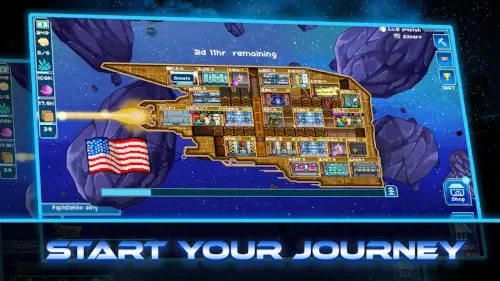
Your ship is shown in cross-section. You see every room, every hallway, every system. You can rearrange rooms by spending resources. Want your shields closer to the reactor? Move them. Want your weapons farther from enemy boarding parties? Relocate them. Layout affects everything.
Recruit and manage crew members
Different roles and abilities
Crew come in different classes. Engineers boost repair speed. Soldiers deal more damage in combat. Scientists improve research rates. Pilots help with evasion. Each crew member also has individual stats. Two soldiers can perform very differently based on their training and equipment.
Assigning crew to rooms
Putting a crew member in the wrong room wastes their potential. Putting an engineer in the weapon room does nothing useful. Putting a soldier in the shield room also does nothing. Match skills to room functions. Check crew stats before assigning anyone.
Fight real players in a persistent galaxy
The galaxy is shared. You see other players’ ships. You can attack them for resources. They can attack you. Your ship continues to exist even when you are offline. That means you need defenses that work without you watching.
Control power, rooms, systems, and resources
Power is limited. Each room needs power to function. Weapons need power to fire. Shields need power to regenerate. Engines need power to dodge. You decide where power goes during battle. Dropping power from one system to boost another is a tactical choice.
Explore planets and discover secrets
You can send crew on planetary missions. Those missions reward resources, equipment, and sometimes new crew. Exploration breaks up the combat loop and gives you something to do when you are not fighting other players.
Form alliances and battle with friends
Alliances let you share strategies, request resources, and coordinate attacks. Some alliance battles are cooperative. You and your allies fight a common enemy. Other battles are competitive. Your alliance ranks against others on leaderboards.
Support crafts to strengthen your ship
Small support ships can be attached to your main vessel. They provide bonuses like extra firepower, faster repairs, or better shields. Choosing the right support craft for your playstyle adds another layer of customization.
Program AI commands for automated combat
Offline play and automatic triggers
Here is a feature that sets Pixel Starships apart. You can program simple AI commands. If shields drop below 20 percent, redirect power from engines. If fire breaks out in the reactor room, send the nearest engineer. These commands run automatically during battles and while you are offline.
Saving time in repetitive battles
AI commands mean you do not have to micromanage every fight. Set up your logic once. Let the system handle routine decisions. That frees you up to focus on bigger strategic choices.
Mix of strategy styles
RTS elements
Real-time strategy shows up in combat. Crew move through rooms. Systems react to damage. Power shifts second by second.
Turn based planning
Ship design and crew assignment happen at your own pace. You can spend hours tweaking your layout without pressure.
4X influences
Explore, expand, exploit, exterminate. You explore new sectors. You expand your ship. You exploit enemy weaknesses. You exterminate anyone who attacks you.
Free to play with optional purchases
Pixel Starships is free. You can build a competitive ship without spending money. Optional purchases include premium currency, speed ups, and cosmetic items. Some players say the grind increases at higher levels. Others say patience solves that problem.
Pixel Starships graphics and design
8 bit and pixel-art visual style
The game looks like it could have run on a Super Nintendo. That is intentional. The pixel art is clean, colorful, and readable. Ships have personality. Crew members are small but distinct.
Cross section ship layout
You see your ship from the side, cut open like a diagram. Rooms are labeled. Crew walk between them. Power flows through lines. That layout makes it easy to see problems at a glance. A red flashing room means damage. A grey room means no power.
Where the design works well
The interface is functional. Buttons are where you expect them. Menus are organized by system. The learning curve comes from strategy depth, not from bad design.
Where it can feel dense
New players often feel overwhelmed. There are many rooms, many crew, many systems. The tutorial covers basics but does not hold your hand through advanced tactics. Expect to spend your first week learning what each room does and how crew skills work.
Pixel Starships User Reviews
The parts people enjoy
Positive reviews often mention the depth. You can play Pixel Starships for months and still find new strategies. The pixel art gets consistent praise. The AI command system is called out as innovative and useful.
The parts people complain about
No strategy game escapes criticism. Here is what comes up most often.
Steep learning curve
New players get lost. The game does not explain room synergy well. It does not tell you which crew skills matter most. Many people quit in the first week because they feel stupid. They are not stupid. The game just expects you to figure things out.
Tutorial could be better
The tutorial teaches basic controls. It does not teach strategy. You will need outside guides, Reddit threads, or YouTube videos to understand advanced concepts.
Demanding for new players
Pixel Starships does not forgive mistakes easily. A bad ship layout can take days to fix. Wrong crew assignments hurt your performance in every battle. The game rewards careful planning and punishes rushing.
Pixel Starships game mechanics
Ship construction as the foundation
Every room matters. Weapons need space. Shields need space. Reactors need space. Corridors connect everything. A poorly designed ship has long walking paths. Crew take too long to reach damaged rooms. That delay loses battles.
Crew assignment and roles
Crew have stats. Training increases those stats. Equipment adds bonuses. A level 1 soldier with a basic rifle fights differently from a level 10 soldier with powered armor. Investing in crew pays off over time.
Power distribution and resource management
You never have enough power. That is by design. You choose which systems stay online during battle. Dropping power from engines to boost weapons makes you easier to hit but harder hitting. Dropping power from shields to boost engines makes you faster but weaker. No right answer. Only trade offs.
Real time and automated combat
Battles happen in real time. Crew move. Weapons fire. Systems break. You can intervene manually or let your AI commands handle things. Most experienced players use a mix of both.
AI command system
You write simple rules. If condition A happens, perform action B. Example: If any room is on fire, set priority to repair that room. Example: If enemy shields are above 50 percent, target shield generator. Good AI logic separates average players from top ranked ones.
Exploration and research progression
Research unlocks new rooms, new weapons, and new crew training options. Exploration missions provide rare resources you cannot get from battles alone. Ignoring either system slows your progress significantly.
Alliance warfare structure
Alliances share a chat and a bank. Members can donate resources to each other. Alliance wars involve coordinated attacks against other alliances. Winning alliance wars rewards rare items and boosts your alliance’s ranking on global leaderboards.
Looking for another space strategy game to try? Check out FTL: Faster Than Light, the PC classic that inspired Pixel Starships. It focuses on crew management and ship combat in a roguelike format.

Pixel Starships Tips
You can learn the basics of Pixel Starships game in an afternoon. Getting good at it takes weeks. These tips separate captains who thrive from captains whose ships get scrapped for parts.
Learn room layout first
Your ship layout is not decoration. It is your primary defense system. Put your reactor in the center, surrounded by armor. Place weapons near the front but behind shields. Keep medical bays close to crew quarters so injured crew heal faster. A bad layout means crew walk too far to fix problems. By the time they arrive, the room is already destroyed. Study successful ship designs from top players. Copy what works. Then modify for your own style.
Keep power distribution efficient
Here is a question. Why do new players lose battles they should win? Because they spread power too thin.
You never have enough power for every system. That is intentional. Choose three or four systems to keep at maximum. Everything else gets minimum power or none at all. During battle, shift power dynamically. Need more firepower? Pull from engines. Taking heavy damage? Pull from weapons to boost shields. Good power management wins fights that bad management loses.
Assign crew based on skills, not randomly
Pixel Starships tips from experienced players all say the same thing. Match crew skills to room functions.
Put your highest repair stat crew in the reactor room. Put your highest attack stat crew near boarding defense positions. Put your highest science stat crew in research labs. A level 10 soldier in a reactor room is useless. A level 5 engineer in that same room keeps your lights on. Check each crew member’s stats before assigning them. Reassign every few levels as their skills grow.
Join alliances early for support
Do not wait. Do not tell yourself you will learn the game first then join later. Join an alliance on day two.
Why so early? Because alliances give you access to shared knowledge. Experienced players answer questions. They share ship layouts. They warn you about common mistakes. Playing Pixel Starships solo means learning everything the hard way. One wrong room placement costs days of resources. An alliance member can point out that mistake before you build it.
Use AI commands for defensive systems
The AI command system is powerful. Most new players ignore it. That is a mistake.
Set simple rules for defensive systems. If shields drop below 30 percent, redirect power from engines. If a fire starts in any room, assign the nearest crew to repair. If your hull goes below 50 percent, activate emergency backup power. These commands run automatically during battles and while you are offline. They turn a reactive defense into a proactive one.
Balance offense and defense
New players love weapons. Big guns. Lots of missiles. They ignore shields, armor, and repair systems.
Then they lose to players with weaker weapons but stronger defenses. A ship that cannot be killed eventually wins against a ship that kills slowly. Aim for a 60-40 split. Sixty percent offense. Forty percent defense. Adjust based on your playstyle. But never go full offense. That ship dies first in every prolonged battle.
Explore and research consistently
Pixel Starships rewards players who do more than fight. Send crew on exploration missions every day. Keep your research labs busy at all times.
Exploration gives rare resources you cannot get from PvP battles. Research unlocks rooms and systems that give you advantages over players who skip research. A player who fights but never explores hits a resource wall. A player who explores but never researches falls behind in technology. Do both. Every day.
Expect a learning curve and take it slow
Here is the honest truth. Your first ship will be bad. Your second ship will be better. Your third ship might be competitive.
Pixel Starships does not hold your hand. The tutorial covers basic controls but not advanced strategy. You will lose battles. You will make layout mistakes. You will assign crew poorly. That is normal. Learn from each loss. Ask questions in alliance chat. Watch videos from experienced players. The game rewards patience, not speed. Take it slow.
Games similar to Pixel Starships
If you like Pixel Starships, here are five other games worth your time. Each offers something similar with a different twist.
FTL: Faster Than Light
FTL is the game that inspired Pixel Starships. You manage a ship in cross-section view. You assign crew. You fight enemies. The difference is that FTL is a single-player roguelike. No online battles. No persistent ship. But the management depth is similar. A must play for anyone who enjoys Pixel Starships similar games on PC.
Crying Suns
Crying Suns combines space combat with crew management and a story campaign. You explore a fallen empire. You make choices that affect your run. The combat is tactical rather than real-time. Good for players who want a narrative alongside their strategy.
Star Trek Fleet Command
Star Trek Fleet Command focuses on base building and ship progression in a licensed universe. You collect officers. You upgrade stations. You fight in alliance wars. The visual style is 3D and cinematic, not pixel art. Good for players who want a bigger budget version of the same genre.
Galaxy on Fire
Galaxy on Fire is a space shooter with trading and upgrade systems. You fly a single ship instead of managing a crew. Battles happen in real time from a cockpit view. Less management. More action. Good for players who like the space setting but want faster gameplay.
EVE Echoes
EVE Echoes is the mobile version of the famous PC space MMO. The economy is deeper. The scale is massive. You can specialize in mining, trading, combat, or manufacturing. Not for casual players. Perfect for people who want to live inside a persistent online universe for months.
Pixel Starships Community
Pixel Starships is built around its community. The game expects you to talk to other players.
Alliances as a core system
Alliances are not optional extras. They are central to progression. Members share resources. They donate items to each other. They coordinate attacks on enemy alliances. The best alliances use external apps like Discord for voice chat and strategy planning. Being in an active alliance cuts your learning time in half.
Multiplayer battles in a shared universe
The galaxy is persistent. Every ship you see belongs to a real player somewhere in the world. You can attack them. They can attack you. Your ship stays in the galaxy even when you close the app. That means you need defenses that work without you watching. It also means revenge attacks are real. Attack someone, and they might come back for you later.
Learning from other players
The Pixel Starships community is active on Reddit, Discord, and YouTube. Experienced players share ship layouts. They post AI command templates. They explain crew training strategies. New players who engage with the community progress much faster than those who play alone. One Reddit thread can save you weeks of trial and error.
Solo vs group play balance
You can play solo for the first few weeks. The game does not force you into alliances immediately. But at a certain point, solo players hit a wall. Resource collection slows down. Battles get harder. Alliance members can donate resources, share repair costs, and provide defensive support. Playing solo is possible but harder. Playing with an alliance is the intended experience.
Conclusion
Pixel Starships works for three types of people. First, management strategy fans who enjoy optimizing systems. Second, retro gamers who appreciate pixel art and 8-bit aesthetics. Third, competitive players who want to test their ship designs against real opponents.
If you fit any of those, the download is worth it.
The learning curve is steep. New players often feel lost. The tutorial could be better. Some players quit in the first week out of frustration. The grind increases at higher levels. Patience is required.
None of these are deal breakers for the right player. But they are honest warnings.
Do you enjoy learning complex systems through trial and error? Or do you prefer games that explain everything up front?
If the first one, Pixel Starships will reward your curiosity with deep mechanics and a supportive community. If the second one, look for strategy games with more hand holding. Both answers are fine. Just know what you are signing up for.
Frequently asked questions about Pixel Starships
How do I get Pixel Starships download on my phone?
Download Pixel Starships from the Official Google Play Store, you can also play on PC with Google Play Games on PC.
Is Pixel Starships free to play, or do I need to spend money?
The game is free. You can build your ship, recruit crew, and fight battles without spending anything. The app makes money from optional purchases like premium currency, speed ups, and cosmetic items. You can progress without paying. It just takes longer. Many players never spend a dollar and still enjoy the game for years.
I have a problem with the app. Who do I contact?
Send an email to the developer support team. They handle bug reports, account recovery, purchase issues, and feature requests. Here is the address: mail[at]savysoda.com.
Is Pixel Starships hard to learn for new players?
Yes, honestly. The game has a steep learning curve. The tutorial covers basic controls but not advanced strategy. Most new players lose their first several battles. That is normal. Join an alliance early. Ask questions. Watch videos from experienced players. The community is helpful. Stick with it for two weeks, and things start to click.