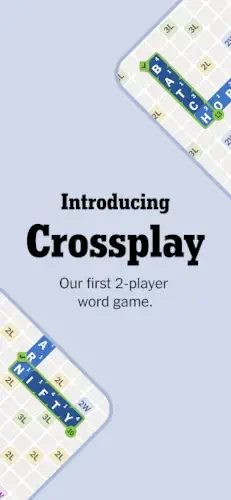
NYT Crossplay is a two player word game from The New York Times Company that blends Scrabble style word building, light competition, social play, and post game analysis into one polished package.
NYT Crossplay game lets you play against friends or computer opponents, review your matches with Cross Bot analysis, and track your progress on leaderboards. You can play on mobile through Google Play or the iOS App Store. You have seen the name around. But what does a real match against a friend actually look like?
Rating: 4.5 stars on Google Play, 4.5 stars on iOS App Store (as of April 2026)
Number of reviews: Over 11.700
Downloads: More the 500.000
Age range: Rated Everyone for mild word game content
If you enjoy social word games with strategic depth, you might also like Words With Friends.
What kind of word game are we playing here?
Two player shared board word battles. You and one opponent. One board. Seven tiles each. That is the whole setup. Simple on paper. Deeper than it looks.
Turn based. You can take hours between turns or minutes. The game waits. No timers. No pressure. You can have a match that lasts two days or twenty minutes. Your choice.
Equal turn rule. Both players get the same number of turns before the match ends. Going first does not give you an extra turn advantage. That small balance feature makes the game fairer than traditional Scrabble where the first player has a mathematical edge.
Not a race. Not a speed test. Pure word strategy. Your vocabulary matters. Your board placement matters. Your patience matters. Your typing speed does not.
NYT Crossplay board and tiles (how the game is built)
Shared board where both players place letters. You build off each other’s words. A good move from your opponent might open a premium scoring spot for you on your next turn.
Each player starts with seven hidden letters. Your opponent cannot see your tray. You cannot see theirs. That hidden information creates tension. You do not know if they are holding the Q or saving an S for a big play.
Letter tiles drawn from a finite bag. When a tile is gone, it is gone. Every E and A you use is one fewer E and A left in the bag. That means late game plays depend on what earlier players left behind.
Match ends after the bag is empty and both players take one final round. The last two turns often decide close matches. Players who save strong letters for the end have an advantage.
How scoring actually works
Score based on letter rarity and board placement. Common letters like E and A are worth fewer points. Rare letters like Q and Z are worth more. That is standard for word games. But NYT Crossplay adds its own twist.
Board placement matters. Some squares multiply your letter score. A Q on a triple letter square becomes three times its normal value. Some squares multiply your entire word score. A seven letter word on a triple word square can swing a match by fifty points.
The game rewards both vocabulary knowledge and board positioning. Knowing the word “qi” is helpful. Knowing where to place it on the board is just as important. A medium word in a premium spot beats a long word in a neutral spot every time.
Playing against friends versus the computer
Challenge friends directly through the app. In game chat and social connection features included. You can taunt your friends. You can discuss strategy. You can just play in silence. The chat is there if you want it.
Play against computer opponents with different difficulty modes. The easy computer makes obvious mistakes. The hard computer plays like a tournament player. You can adjust difficulty as you improve.
Computer practice helps you learn patterns before facing real opponents. The computer does not get bored. The computer does not care if you take ten minutes to think. Use computer matches to test new strategies.
Multiple simultaneous matches allowed. You can have three or four games running at once against different people. Take a turn in one game. Switch to another. Play at your own pace across multiple opponents.
Cross Bot (the post game coach you did not know you needed)
Built in post game analysis tool called Cross Bot. After each match, Cross Bot reviews your plays and shows you what you missed.
Reviews your match and shows missed opportunities. That word you did not see? Cross Bot highlights it. That better placement you overlooked? Cross Bot points it out.
Highlights better words you could have played. Not just longer words. Higher scoring words. Words that fit the board better. Words that set up your next turn.
This is the feature that separates NYT Crossplay from Scrabble GO or Words With Friends. Those apps tell you who won. Cross Bot tells you why you won or lost. That feedback loop makes you a better player over time. You learn from every match, win or lose.
The part that frustrates new players (technical performance)
Research and reviews say it directly. Bugs. Slow loading. Crashes. Interface quirks.
Some users report the game runs smoothly. Others say it feels rough on their device. The experience is inconsistent. One player with a new Phone has no issues. Another player with a similar phone reports constant crashes.
Zoom behavior on mobile can be inconsistent. Pinching to zoom the board sometimes works. Sometimes it does not. That frustration comes up repeatedly in user reviews.
Short term advice: try the app on your device before committing to a subscription. Performance varies by phone model and OS version. The game is free to download. Play a few matches against the computer. See how it runs on your specific device. Then decide if you want to pay for the full NYT Games subscription.
NYT Crossplay User Reviews
Positive feedback focuses on four things. Fun and competitive matches keep you coming back. Easy to play with friends across different schedules. Enjoyable against computer when no friends are available. Polished NYT style presentation looks clean and professional.
Negative feedback focuses on technical issues. Bugs that freeze the board. Slow loading between turns. Crashes that lose match progress. Interface quirks that make tile placement harder than it should be.
But here is the interesting part. Players who complain about bugs often still praise the gameplay. The concept works. The execution needs polish on certain devices. No one says the game is boring. No one says the word selection is bad. The complaints are about performance, not design. Those are fixable problems.
NYT Crossplay tips that save you from losing every match
You do not need to be a Scrabble champion to win at this NYT Crossplay game. You need a few habits that turn close losses into close wins.
Look for ways to create more than one word from a single placement. One tile can complete two words at once. Place an S at the end of “CAT” to make “CATS” while also creating “SAND” going down. That doubles your score for that turn. Two words. One move. Big points.
Pay attention to bonus tiles and board edges. Corners and premium squares give higher scores. A triple word score on the edge of the board can turn a five point word into a fifteen point word. Plan your moves around those squares. Do not just play the first word you see.
Shuffle your tray often. Rearranging letters reveals new word patterns you might have missed. Your brain gets stuck on one arrangement. Shuffle. Look again. A word that was invisible before will suddenly appear.
Keep track of the tile bag. If you know which letters are left, you can predict what your opponent might draw. Four E’s left? Your opponent probably has one. No S’s left? Do not wait for an S to pluralize your word. Play something else.
Use the final turns carefully. Both players get the same number of turns. The last two turns often decide close matches. Save a strong play for the final round. Your opponent cannot respond after the game ends. A ten point lead going into the last turn is not safe if they have the Q and a triple word spot.
Save strong letters like Q, Z, J, and X for premium scoring spots. Do not waste them on a low value word just because you can. That Q on a double letter square next to a triple word square is a fifty point swing. That same Q on a neutral square is ten points. Patience pays off.
Use Cross Bot feedback after matches. The bot shows you better plays. Learn from it. That word you missed? Remember it for next time. That placement you overlooked? Look for similar patterns in future games. Cross Bot is not judging you. Cross Bot is coaching you.
Practice against the computer before jumping into harder friend matches. The computer does not get offended if you take ten minutes to think. Try new strategies. Test risky words. Lose to the computer. Learn. Then beat your friends.
These NYT Crossplay tips will raise your win rate. The difference between a good player and a great player is not vocabulary. It is board awareness and patience.
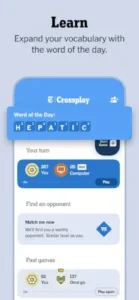
The curated dictionary (what words actually count)
NYT Crossplay uses a curated dictionary, not every word in the English language. The New York Times chooses words that are common, recognizable, and appropriate for general audiences.
Slang, abbreviations, and obscure technical terms may not be accepted. That twenty letter medical term you learned in college? Probably not in the dictionary. That regional slang word your family uses? Also probably not.
The dictionary leans toward common, recognizable words. If you have seen the word in a newspaper or a novel, it is likely accepted. If you have only seen it in a specialized textbook, test it first.
If a word feels too niche, test it. The game will reject invalid words without penalty. There is no punishment for guessing. Try the word. If it works, great. If not, try something else. You lose nothing by testing.
Subscription and NYT Games access
NYT Crossplay is part of the New York Times Games suite. That means it sits alongside Wordle, The Crossword, Spelling Bee, and other NYT puzzle games.
A NYT Games subscription unlocks full access. Subscribers get unlimited matches, full Cross Bot analysis, and no ads. The subscription also includes all other NYT Games.
Free tier may have limitations on matches or features. You can download the app and play without paying. But you may face limits on how many simultaneous matches you can run or how much Cross Bot analysis you can access.
Check current pricing on the official website before downloading. NYT Games subscription prices change. A bundle with News and Games costs different from Games only. Read the pricing page. Know what you are paying for.
NYT Crossplay Similar Games
| App | Why it helps you understand NYT Crossplay |
|---|---|
| Scrabble GO | Turn based word board play. Same tile placement mechanics. Different monetization. Scrabble GO has more ads. NYT Crossplay has Cross Bot. |
| Words With Friends | Social word battles with friends. Similar chat and turn based structure. Words With Friends has a larger player base. NYT Crossplay has better post game analysis. |
| Wordfeud | Classic board word competition. Simpler interface, same core loop. Wordfeud is more bare bones. NYT Crossplay is more polished visually. |
| NYT Games Word style puzzles | Vocabulary and strategy based word play. Familiar dictionary. If you play Spelling Bee, you already know which words the NYT accepts. |
| Letterpress | Shared board word strategy. Different scoring system but similar shared board tension. Letterpress is about controlling territory. NYT Crossplay is about scoring points. |
If you searched for NYT Crossplay similar games before reading this, you already know you like word battles. The difference here is the analysis tool. Cross Bot changes how you learn.
NYT Crossplay community and social features
Friendly competition through friend matching and leaderboards. You can see how you rank against your friends. You can see how you rank globally. The leaderboard gives you a reason to keep playing.
In game chat lets you taunt friends or discuss strategy. A simple “good game” after a close match. A friendly “how did you see that word?” The chat is optional but adds a social layer.
Analysis tools encourage players to share and discuss matches. Send a Cross Bot report to your friend after a match. Say “look at the word I missed.” That shared learning experience is rare in word games.
The broader community comes from NYT Games subscribers and word game fans who use the NYT Crossplay game as both a pastime and a skill building tool. The NYT brand attracts a certain type of player. More serious about words. More interested in learning. Less interested in flashy animations.
Searching for NYT Crossplay codes? NYT does not typically release promo codes for free plays. The subscription model is straightforward. Pay monthly or yearly. No code hunting required.
Equal turn rule (why it matters)
Both players get the same number of turns before the match ends. That sounds simple. But most word games do not work this way.
Going first does not give you an extra turn advantage. In traditional Scrabble, the first player gets one more turn than the second player if the tiles run out. That is a small but real advantage.
The player who starts gets turn one. The player who starts also gets the final turn if the total number of turns is odd. That means the first player gets the first word and the last word. But the second player gets the same number of total turns.
That small balance feature makes the game fairer than traditional Scrabble where going first is an advantage. Every match feels winnable from either starting position. No blaming the coin flip.
Conclusion
NYT Crossplay modernizes classic tile based word competition with social features, post game coaching, and a clean NYT style presentation. The app looks good. The analysis tool helps you improve. The equal turn rule keeps matches fair.
The game has technical rough edges on some devices. Slow loading. Occasional crashes. Inconsistent zoom behavior. But the core loop of shared board word building works. When the app runs smoothly, it is the best two player word game on mobile.
Other word games let you play. NYT Crossplay teaches you to play better.
Is that a feature or a threat to your ego?
That depends on whether you want to win or you want to learn.
FAQ
What exactly is NYT Crossplay?
It is a two player word game. The first of its kind from the team behind the New York Times word puzzles. You get a board. You get an opponent. You take turns forming words. The goal is simple: outscore the other person. No timer pressure. No frantic tapping. Just thoughtful word building.
Where can I download NYT Crossplay?
Download NYT Crossplay from the Official Google Play Store
You can also play on PC with Google Play Games on PC
Is there an official website where I can learn more?
Yes. The official NYT Crossplay website has rules and updates.
I need help with something in the game. Who do I contact?
Send an email to the developer support team. They handle bug reports, account questions, and feature feedback. Here is the address: nytgames[at]nytimes.com.
Do I need a New York Times subscription to play?
No. That is a common question. The game stands alone. You can play as a guest or create a free account to track stats. Subscribers get a few cosmetic extras, but the core game is fully open to everyone. Fair matchmaking. No pay to win.